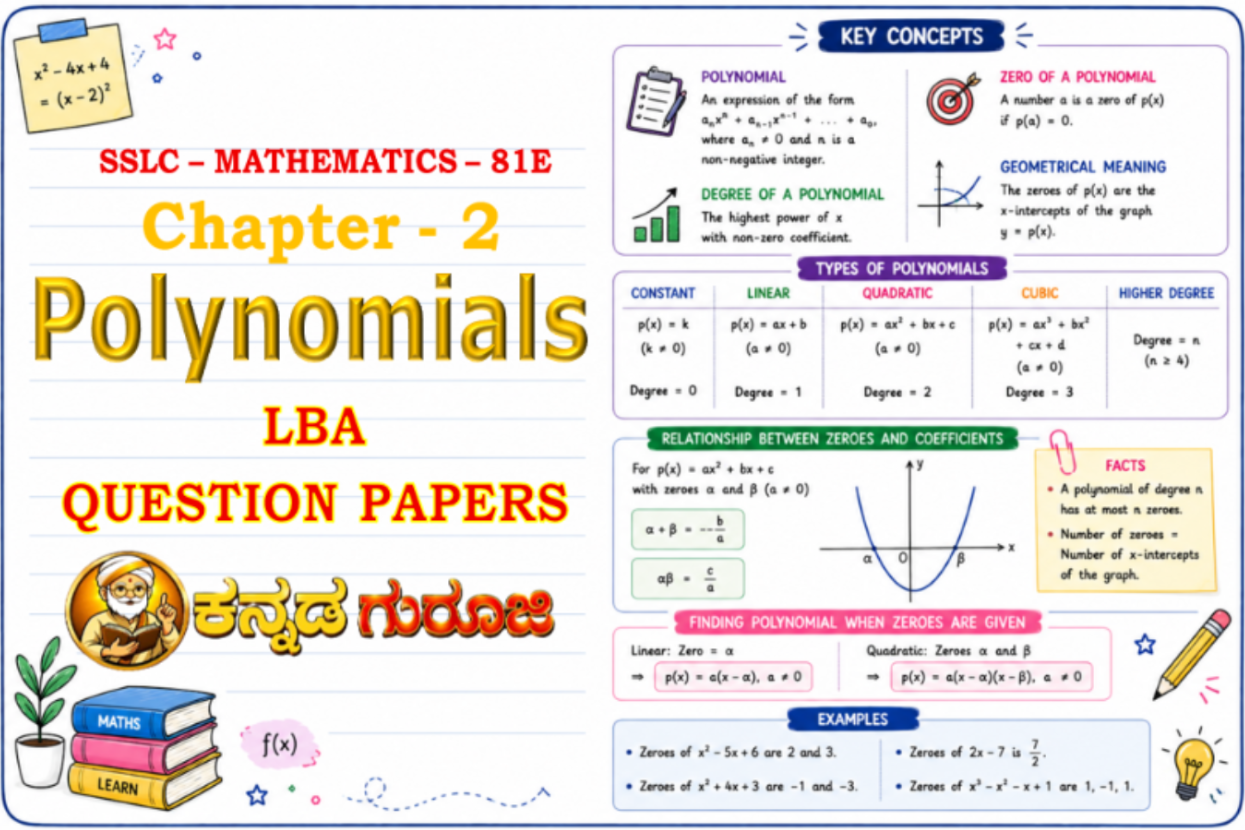
Mathematics is one of the most important subjects in the Karnataka SSLC curriculum, and Chapter 2 – Polynomials is one of the most significant chapters in Algebra. This chapter introduces students to polynomial expressions, their degrees, zeroes, and relationships between coefficients and zeroes. It also develops the algebraic thinking required to solve higher-level mathematical problems. A clear understanding of Polynomials helps students solve questions related to algebraic identities, quadratic equations, coordinate geometry, and many other advanced mathematical concepts. Since this chapter forms the foundation for several topics in higher Mathematics, students should develop conceptual clarity before proceeding to the remaining chapters.
To help students strengthen their understanding of this chapter, the Karnataka School Examination and Assessment Board (KSEAB) conducts Lesson Based Assessment (LBA) tests. These assessments are designed to evaluate students' conceptual understanding, logical reasoning, and ability to apply mathematical ideas rather than simply testing their memory. Students who regularly practice LBA question papers become more confident in solving competency-based, analytical, and application-oriented questions.
On this page, students can download SSLC Mathematics Chapter 2 – Polynomials LBA & Marusinchana Question Papers in Version A, Version B, Version C, and Version D. All four versions are prepared according to the latest Karnataka SSLC syllabus and are highly useful for classroom assessments, revision, and examination preparation.
What is Lesson Based Assessment (LBA)?
Lesson Based Assessment (LBA) is a competency-based assessment system introduced to improve students' conceptual understanding and learning outcomes. Unlike traditional examinations that mainly focus on memorized answers, LBA encourages students to understand concepts thoroughly, apply mathematical ideas, analyze problems, and arrive at logical solutions.
In Mathematics, memorizing formulas alone is not enough. Students should understand how mathematical concepts are connected and how formulas can be applied to different situations. LBA question papers are designed with this objective in mind.
The assessment includes questions that evaluate logical reasoning, conceptual understanding, analytical ability, mathematical accuracy, and problem-solving techniques. Regular practice of these question papers helps students become familiar with competency-based questions and prepares them for school examinations as well as future competitive examinations.
Importance of Chapter 2 – Polynomials
Polynomials form one of the most important chapters in SSLC Mathematics because they introduce the basic concepts of Algebra. Every student who wishes to study higher Mathematics should have a strong understanding of polynomial expressions and their properties.
This chapter helps students understand the degree of a polynomial, different types of polynomials, zeroes of a polynomial, graphical interpretation of zeroes, the relationship between zeroes and coefficients, and methods for finding a polynomial when its zeroes are known. These concepts are frequently used in later chapters and are essential for solving advanced algebraic problems.
A strong understanding of Polynomials helps students:
- Build a strong foundation in Algebra.
- Improve logical and analytical thinking.
- Identify different types of polynomials correctly.
- Find the degree of a polynomial accurately.
- Determine the zeroes of a polynomial.
- Understand the relationship between zeroes and coefficients.
- Solve graph-based polynomial questions confidently.
- Develop confidence for higher Mathematics.
Since many school examinations and competitive examinations include questions from Polynomials, mastering this chapter provides long-term academic benefits.
Concepts Covered in Chapter 2 – Polynomials
The LBA question papers are prepared based on all the important concepts included in Chapter 2.
Major topics include:
- Degree of a Polynomial
- Types of Polynomials
- Constant, Linear, Quadratic and Cubic Polynomials
- Zeroes of a Polynomial
- Geometrical Meaning of the Zeroes
- Relationship Between Zeroes and Coefficients
- Finding a Polynomial When Its Zeroes are Given
- Polynomial Verification Problems
- Graph-Based Questions
- Competency-Based Application Problems
Students should thoroughly understand each topic before attempting the LBA question papers because every concept contributes to developing strong algebraic skills.
Why Practice Polynomials LBA Question Papers?
Practicing LBA question papers provides much more than examination practice. It helps students improve algebraic thinking, understand mathematical relationships, and develop confidence in solving competency-based problems.
Some important benefits include:
- Improves conceptual understanding.
- Develops analytical thinking.
- Strengthens logical reasoning.
- Improves algebraic manipulation skills.
- Enhances problem-solving ability.
- Builds examination confidence.
- Helps identify weak areas.
- Improves mathematical accuracy.
- Develops time management skills.
- Prepares students for competency-based assessments.
Students who solve multiple LBA question papers generally perform better in classroom assessments because they become familiar with different styles of questions and different methods of solving problems.
SSLC Mathematics Chapter 2 LBA Question Papers (Version A, B, C & D)
The Karnataka Department of School Education has introduced Lesson Based Assessment and Marusinchana programmes to improve conceptual learning among students.
In most English Medium schools, the complete 20-mark unit assessment follows the LBA pattern.
In schools implementing the Marusinchana Programme, 15 marks are allotted to LBA questions, while the remaining 5 marks are based on the Marusinchana assessment pattern.
To help students prepare effectively, Chapter 2 Polynomials question papers are available in four versions:
- Version A
- Version B
- Version C
- Version D
Practicing all four versions helps students understand different question patterns while covering the complete syllabus prescribed for the chapter.
Information about Version A, Version B, Version C & Version D
To ensure fairness during classroom assessments, the Karnataka School Examination and Assessment Board (KSEAB) prepares four versions of every LBA question paper.
Although the questions, numerical values, or sequence may vary across the four versions, every paper is designed according to the latest Karnataka SSLC Mathematics curriculum. Students are assessed using identical educational standards, ensuring that each version provides a balanced evaluation of conceptual understanding, logical reasoning, and mathematical application.
Students are encouraged to practice all four versions because every paper introduces different question patterns while covering the same learning objectives.
Version A LBA Question Paper
Version A contains a balanced combination of objective, short-answer, descriptive, competency-based, and graph-based questions from Chapter 2.
Students can use this version to:
- Understand the examination pattern.
- Practice conceptual questions.
- Improve algebraic reasoning.
- Strengthen graph interpretation skills.
- Build confidence before school assessments.
Version B LBA Question Paper
Version B follows the same assessment framework while presenting another carefully prepared set of questions from Chapter 2.
This version helps students:
- Practice additional competency-based questions.
- Improve analytical thinking.
- Solve different algebraic problems.
- Strengthen conceptual understanding.
- Gain confidence through repeated practice.
Version C LBA Question Paper
Version C introduces another carefully prepared set of questions covering all the important concepts of Polynomials. This version is designed to help students strengthen their conceptual understanding and improve their ability to solve competency-based questions with confidence.
The questions in Version C focus on applying polynomial concepts in different situations rather than simply recalling formulas. Students will encounter questions related to the degree of a polynomial, different types of polynomials, graphical representation of zeroes, the relationship between zeroes and coefficients, and constructing polynomials from the given zeroes.
Practicing Version C helps students:
- Strengthen conceptual clarity.
- Improve logical reasoning.
- Revise important algebraic concepts.
- Develop confidence in solving graph-based questions.
- Improve application of polynomial properties.
Students should complete this version after practicing Versions A and B to gain better exposure to different styles of questions.
Version D LBA Question Paper
Version D provides another opportunity for students to evaluate their preparation through a different set of competency-based questions. Although the question pattern varies slightly from the previous versions, it covers the same learning outcomes prescribed in the Karnataka SSLC syllabus.
Students should attempt Version D only after completing Versions A, B, and C. By the time they solve this paper, they will have revised almost every important concept from the chapter and gained confidence in handling different types of questions.
Completing all four versions enables students to:
- Experience different question patterns.
- Improve conceptual understanding.
- Develop better examination confidence.
- Strengthen algebraic reasoning.
- Prepare thoroughly for classroom assessments.
Types of Questions Included
The Chapter 2 LBA Question Papers include different categories of questions that evaluate multiple learning skills. The questions are designed to assess not only knowledge but also the ability to apply concepts correctly in various mathematical situations.
These include:
- Multiple Choice Questions (MCQs)
- Fill in the Blanks
- One-Mark Questions
- Short Answer Questions
- Competency-Based Questions
- Application-Based Questions
- Graph-Based Questions
- Logical Reasoning Questions
- Polynomial Verification Problems
- Mathematical Calculation Problems
This combination of questions helps students develop conceptual understanding, analytical thinking, and practical problem-solving ability.
How to Prepare for Chapter 2 – Polynomials
A systematic preparation strategy can significantly improve performance in Lesson Based Assessment examinations.
Understand Every Concept
Begin by understanding the meaning of a polynomial, its degree, coefficient, variable, and zeroes. Avoid memorizing definitions without understanding their practical meaning.
Learn Different Types of Polynomials
Students should clearly distinguish between constant, linear, quadratic, cubic, and higher-degree polynomials. This concept is frequently tested in examinations.
Practice Finding Zeroes
Finding the zeroes of a polynomial is one of the most important skills in this chapter. Practice several examples until the procedure becomes familiar.
Learn the Relationship Between Zeroes and Coefficients
Students should understand how the sum and product of zeroes are related to the coefficients of a quadratic polynomial. This concept is frequently used in competency-based questions.
Practice Graph-Based Questions
Study how graphs represent the zeroes of a polynomial. Learn to identify the number of zeroes directly from graphical representations.
Solve All Four Versions
Attempt Version A, Version B, Version C, and Version D without referring to notes. This improves confidence and exposes students to different question patterns.
Revise Regularly
Revision is essential for retaining algebraic concepts and improving examination performance.
Common Mistakes Students Should Avoid
Many students lose marks because of avoidable mistakes rather than a lack of knowledge.
Common mistakes include:
- Memorizing formulas without understanding concepts.
- Confusing the degree of a polynomial with its coefficient.
- Incorrectly identifying different types of polynomials.
- Ignoring negative signs while solving problems.
- Making calculation mistakes.
- Not practicing graph-based questions.
- Skipping verification of answers.
- Not attempting all four versions.
- Poor time management during examinations.
Avoiding these mistakes can significantly improve examination performance.
Benefits of Solving All Four Versions
Practicing all four versions offers several advantages.
Students can:
- Experience different question patterns.
- Improve conceptual understanding.
- Increase confidence.
- Strengthen algebraic reasoning.
- Develop faster calculation skills.
- Improve logical thinking.
- Learn better time management.
- Prepare effectively for competency-based assessments.
- Identify weak concepts before examinations.
The more question papers students solve, the better prepared they become for school assessments and the SSLC Board Examination.
Download SSLC Mathematics Chapter 2 Polynomials LBA Question Papers PDF
Students can download all four versions of the Chapter 2 Polynomials LBA Question Papers below.
📄 Version A – PDF Download
📄 Version B – PDF Download
📄 Version C – PDF Download
📄 Version D – PDF Download
Students are advised to solve the papers in the order of Version A, Version B, Version C, and finally Version D. This systematic approach helps in effective revision and builds confidence before the examination.
Frequently Asked Questions
1. What is the duration of the Chapter 2 LBA examination?
The Chapter 2 Polynomials LBA examination is conducted for 40 minutes.
2. How many marks is the Chapter 2 LBA test?
The test carries 20 marks.
3. Are Versions A, B, C, and D different?
Yes. The questions and their sequence may vary across the four versions, but each paper is prepared according to the Karnataka SSLC Mathematics curriculum and assesses the same learning outcomes.
4. Should students solve all four versions?
Yes. Practicing all four versions improves confidence and familiarizes students with different question patterns.
5. Which topics are most important in Polynomials?
The degree of a polynomial, types of polynomials, zeroes of a polynomial, graphical interpretation, relationship between zeroes and coefficients, and constructing a polynomial from given zeroes are among the most important topics.
6. Are these question papers useful for school examinations?
Yes. They are specifically prepared according to the Lesson Based Assessment (LBA) pattern and are highly useful for school unit tests.
7. Can these papers improve examination performance?
Regular practice improves conceptual understanding, algebraic reasoning, calculation accuracy, and examination confidence.
8. Where can I download all four versions?
Students can download Version A, Version B, Version C, and Version D from this page.
Conclusion
Chapter 2 – Polynomials is one of the most important chapters in SSLC Mathematics because it establishes a strong foundation in Algebra. Concepts such as the degree of a polynomial, zeroes of a polynomial, graphical interpretation, and the relationship between zeroes and coefficients are essential for understanding several higher-level mathematical topics.
To achieve the best results, students should regularly practice Version A, Version B, Version C, and Version D of the LBA & Marusinchana Question Papers. Solving multiple versions improves conceptual understanding, strengthens algebraic reasoning, enhances problem-solving skills, and builds confidence for classroom assessments as well as the final SSLC Board Examination.
Download the SSLC Mathematics Chapter 2 – Polynomials LBA & Marusinchana Question Papers PDF today and begin your preparation with confidence. Consistent practice, regular revision, and a clear understanding of polynomial concepts are the keys to scoring excellent marks in Mathematics.