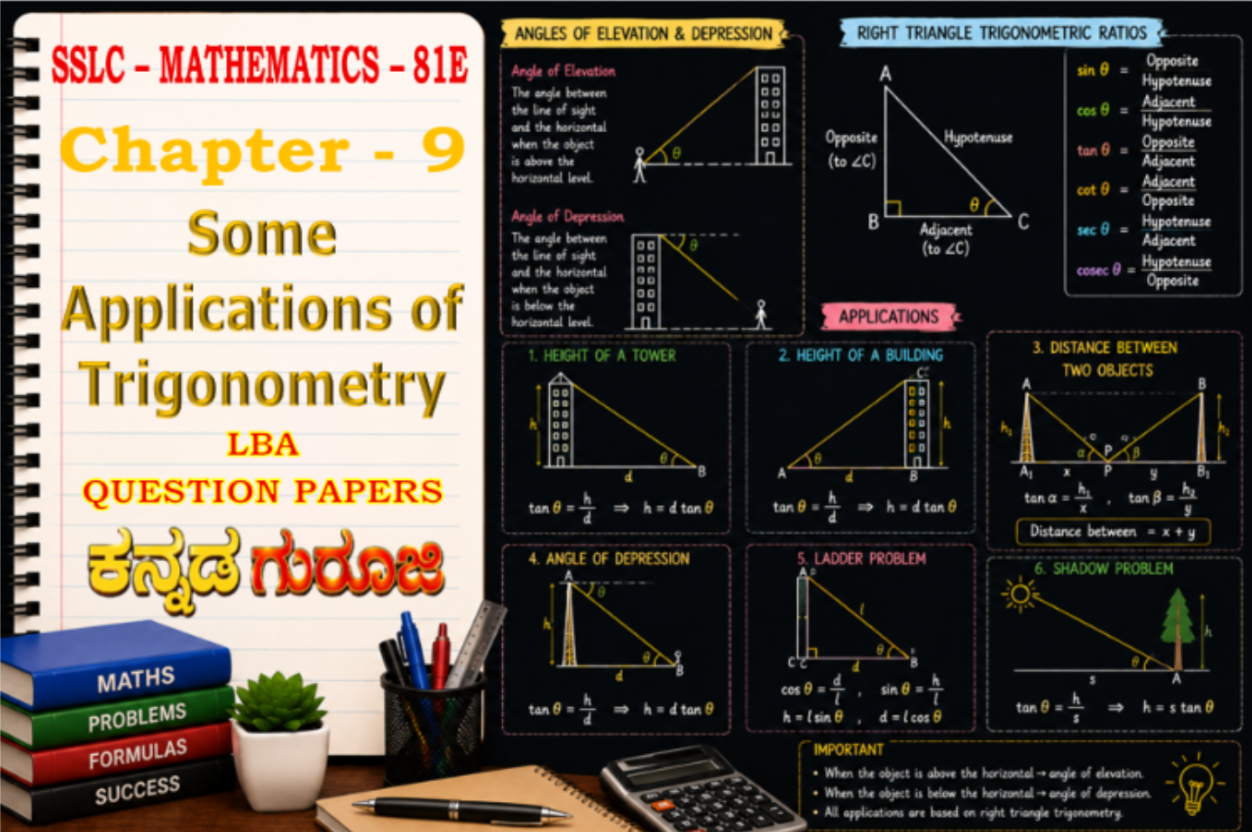
Mathematics is one of the most important subjects in the Karnataka SSLC curriculum, and Chapter 9 – Some Applications of Trigonometry is one of the most practical and real-life oriented chapters in the syllabus. Unlike the previous chapter, which introduces trigonometric ratios and identities, this chapter demonstrates how Trigonometry can be applied to solve everyday problems involving heights, distances, angles of elevation, and angles of depression.
The concepts learned in this chapter help students determine the height of towers, buildings, poles, trees, lighthouses, hills, and other objects without measuring them directly. Students also learn how to calculate unknown distances using angles observed from different positions. These applications make Trigonometry highly useful in engineering, architecture, surveying, navigation, aviation, astronomy, construction, and many scientific fields.
To strengthen students' conceptual understanding, the Karnataka School Examination and Assessment Board (KSEAB) conducts Lesson Based Assessment (LBA) examinations. These assessments are designed to evaluate conceptual clarity, logical reasoning, analytical thinking, and the ability to apply mathematical concepts in real-life situations rather than testing memorized formulas. Students who regularly practice LBA Question Papers become more confident in solving competency-based and application-oriented questions.
On this page, students can download SSLC Mathematics Chapter 9 – Some Applications of Trigonometry LBA Question Papers in Version A, Version B, Version C, and Version D. These question papers are prepared according to the latest Karnataka SSLC syllabus and are highly useful for classroom assessments, revision, and examination preparation.
What is Lesson Based Assessment (LBA)?
Lesson Based Assessment (LBA) is a competency-based evaluation system introduced to improve students' conceptual understanding and learning outcomes. Unlike traditional examinations that mainly focus on memorized answers, LBA encourages students to understand mathematical concepts thoroughly, apply formulas appropriately, analyze situations logically, and arrive at accurate solutions.
In this chapter, students are expected to identify right-angled triangles from real-life situations, draw appropriate diagrams, choose the correct trigonometric ratio, and calculate unknown heights or distances accurately.
The assessment evaluates conceptual understanding, logical reasoning, analytical thinking, mathematical accuracy, diagram interpretation, and practical problem-solving skills. Regular practice of these question papers helps students improve confidence, strengthen conceptual clarity, and become familiar with the latest Karnataka assessment pattern.
Importance of Chapter 9 – Some Applications of Trigonometry
Some Applications of Trigonometry is one of the most practical chapters in SSLC Mathematics because it demonstrates how trigonometric concepts are used in everyday life. Instead of solving only theoretical problems, students learn how to determine unknown heights and distances by observing objects from different positions.
The chapter introduces important concepts such as the line of sight, angle of elevation, and angle of depression, which are widely used in surveying, civil engineering, architecture, aviation, navigation, construction, military operations, and geographical measurements.
Students learn how to solve problems involving towers, buildings, trees, poles, windmills, lighthouses, aircraft, balloons, transmission towers, and other real-life situations by applying trigonometric ratios and logical reasoning.
A strong understanding of this chapter helps students:
- Build practical problem-solving skills.
- Apply trigonometric ratios confidently.
- Understand angle of elevation and angle of depression.
- Interpret real-life situations mathematically.
- Improve analytical thinking.
- Develop diagram-drawing skills.
- Solve application-based competency questions.
- Prepare for higher Mathematics and competitive examinations.
Since this chapter frequently appears in classroom assessments and board examinations, mastering these concepts provides long-term academic benefits. The official LBA learning outcomes specifically cover angle of elevation, angle of depression, line of sight, and application problems.
Concepts Covered in Chapter 9
The LBA Question Papers are prepared based on all the important learning outcomes prescribed for Chapter 9.
Major topics include:
- Line of Sight
- Angle of Elevation
- Angle of Depression
- Heights and Distances
- Right-Angled Triangle Applications
- Solving Real-Life Trigonometry Problems
- Towers and Buildings
- Trees and Poles
- Windmills and Lighthouses
- Aircraft and Balloon Problems
- Competency-Based Questions
- Application-Based Questions
Students should understand every concept thoroughly before attempting the LBA Question Papers because each topic contributes to developing strong analytical reasoning and practical mathematical problem-solving skills. The official LBA material includes application-based questions involving towers, shadows, buildings, poles, aircraft, balloons, lighthouses, transmission towers, and similar real-life scenarios.
Why Practice Some Applications of Trigonometry LBA Question Papers?
Practicing LBA Question Papers provides much more than examination practice. It helps students strengthen their understanding of real-life trigonometry, improve calculation accuracy, and develop confidence in solving competency-based mathematical problems.
Some important benefits include:
- Improves conceptual understanding.
- Develops analytical thinking.
- Strengthens logical reasoning.
- Improves diagram interpretation skills.
- Enhances problem-solving ability.
- Builds examination confidence.
- Helps identify weak concepts.
- Improves mathematical accuracy.
- Develops time management skills.
- Prepares students for competency-based assessments.
Students who regularly solve multiple LBA Question Papers become familiar with different question patterns and perform better in classroom assessments.
SSLC Mathematics Chapter 9 LBA Question Papers (Version A, B, C & D)
The Karnataka School Examination and Assessment Board (KSEAB) prepares Lesson Based Assessment Question Papers to evaluate students' conceptual understanding, reasoning ability, and application of Trigonometry concepts in practical situations.
Instead of focusing only on theoretical knowledge, these assessments encourage students to analyze diagrams, identify right-angled triangles, apply trigonometric ratios correctly, and solve real-life problems involving heights, distances, and observation angles.
To ensure fairness during classroom assessments, the Chapter 9 Question Papers are prepared in four different versions:
- Version A
- Version B
- Version C
- Version D
Although each version contains different numerical values, diagrams, or question arrangements, every paper follows the latest Karnataka SSLC Mathematics syllabus and evaluates the same learning outcomes. Practicing all four versions gives students exposure to a variety of competency-based questions while strengthening every important concept covered in the chapter.
Information about Version A, Version B, Version C & Version D
To provide equal assessment opportunities, four versions of the Chapter 9 LBA Question Paper are prepared.
Each version evaluates the same concepts but presents different real-life situations, diagrams, numerical values, or question arrangements. This approach encourages students to understand mathematical concepts rather than memorize answers.
Practicing all four versions helps students:
- Become familiar with different question patterns.
- Improve conceptual understanding.
- Strengthen analytical reasoning.
- Increase examination confidence.
- Prepare effectively for classroom assessments.
Version A LBA Question Paper
Version A contains a balanced combination of objective, short-answer, competency-based, diagram-based, and application-oriented questions from Chapter 9.
Students can use this version to:
- Understand the examination pattern.
- Practice angle of elevation and angle of depression problems.
- Improve diagram interpretation.
- Strengthen real-life trigonometry concepts.
- Build confidence before school assessments.
Version B LBA Question Paper
Version B follows the same assessment framework while presenting another carefully prepared collection of questions covering all the major concepts of Some Applications of Trigonometry.
Practicing this version helps students:
- Solve additional competency-based questions.
- Improve analytical thinking.
- Strengthen application of trigonometric ratios.
- Revise heights and distances problems.
- Gain confidence through continuous practice.
Version C LBA Question Paper
Version C introduces another carefully prepared set of questions covering all the important concepts of Some Applications of Trigonometry. This version is designed to strengthen students' conceptual understanding and improve their ability to solve competency-based and application-oriented questions with confidence.
The questions in Version C focus on identifying the angle of elevation and angle of depression in different situations, drawing appropriate diagrams, applying trigonometric ratios correctly, and solving practical problems involving heights and distances. Students are encouraged to understand the relationship between real-life situations and mathematical concepts instead of memorizing procedures.
Practicing Version C helps students:
- Strengthen conceptual clarity.
- Improve logical reasoning.
- Revise important trigonometric applications.
- Develop confidence in solving diagram-based questions.
- Improve application of heights and distances concepts.
Students should complete this version after practicing Versions A and B to gain better exposure to different question patterns and strengthen their overall preparation.
Version D LBA Question Paper
Version D provides students with another opportunity to evaluate their preparation through a different collection of competency-based and application-oriented questions. This version covers all the important learning outcomes prescribed for Chapter 9 and helps students assess their readiness before appearing for classroom assessments.
The question paper includes problems based on line of sight, angle of elevation, angle of depression, towers, buildings, poles, windmills, transmission towers, aircraft, balloons, lighthouses, and other practical applications of Trigonometry.
Students should attempt Version D after completing Versions A, B, and C. Solving all four versions helps students revise the complete chapter thoroughly and become confident in solving different styles of application-based trigonometry questions.
Completing all four versions enables students to:
- Experience different question patterns.
- Improve conceptual understanding.
- Strengthen analytical reasoning.
- Enhance real-life problem-solving skills.
- Prepare effectively for school assessments.
Types of Questions Included
The Chapter 9 LBA Question Papers contain different categories of questions designed to evaluate conceptual understanding, logical reasoning, and practical mathematical skills.
These include:
- Multiple Choice Questions (MCQs)
- Fill in the Blanks
- One-Mark Questions
- Short Answer Questions
- Competency-Based Questions
- Application-Based Questions
- Diagram-Based Questions
- Heights and Distances Problems
- Angle of Elevation and Depression Questions
- Real-Life Trigonometry Problems
This balanced combination of questions helps students improve conceptual understanding, mathematical accuracy, and practical problem-solving skills. The official LBA material contains a wide variety of competency-based questions involving shadows, towers, poles, buildings, windmills, aircraft, balloons, transmission towers, and lighthouses.
Question Paper Structure
The Chapter 9 LBA Question Papers follow the latest assessment pattern prescribed for Karnataka SSLC students.
Each question paper generally includes:
- Total Marks: 20
- Duration: 40 Minutes
- Total Questions: 11
The assessment consists of:
- Multiple Choice Questions
- One-Mark Questions
- Two-Mark Questions
- Three-Mark Questions
- Four-Mark Question
The paper is carefully designed to evaluate conceptual understanding, reasoning ability, diagram interpretation, mathematical calculations, and the application of Trigonometry concepts in real-life situations.
How to Prepare for Chapter 9 – Some Applications of Trigonometry
A systematic preparation strategy can significantly improve performance in Lesson Based Assessment examinations.
Understand the Basic Concepts
Begin by understanding the meaning of line of sight, angle of elevation, and angle of depression. Students should clearly identify these angles in different practical situations before attempting numerical problems.
Draw Accurate Diagrams
Most application problems become easier when a proper right-angled triangle is drawn. Practice sketching neat diagrams and labeling all known measurements correctly.
Choose the Correct Trigonometric Ratio
Before solving a problem, identify which trigonometric ratio—sine, cosine, or tangent—is appropriate for the given information. Applying the correct ratio is essential for obtaining accurate answers.
Practice Heights and Distances Problems
Solve a variety of questions involving towers, buildings, poles, trees, windmills, lighthouses, aircraft, and balloons. These practical examples improve analytical thinking and build confidence.
Improve Calculation Accuracy
Practice calculations involving square roots and standard trigonometric values. Careful calculations help avoid unnecessary mistakes during examinations.
Practice All Four Versions
Attempt Version A, Version B, Version C, and Version D without referring to notes. Solving all versions exposes students to different question patterns and strengthens conceptual understanding.
Revise Regularly
Regular revision helps students retain formulas, improve speed, and reduce calculation errors during examinations.
Common Mistakes Students Make
Many students lose marks because of avoidable mistakes rather than a lack of knowledge.
Common mistakes include:
- Confusing angle of elevation with angle of depression.
- Drawing incorrect right-angled triangle diagrams.
- Selecting the wrong trigonometric ratio.
- Using incorrect standard trigonometric values.
- Making calculation errors while simplifying expressions.
- Ignoring units in practical problems.
- Misinterpreting the given information.
- Spending too much time on lengthy calculations.
- Practicing only one version of the question paper.
Avoiding these mistakes helps students improve mathematical accuracy and examination performance.
Benefits of Solving All Four Versions
Practicing all four versions provides students with comprehensive preparation for classroom assessments.
Students can:
- Experience different question patterns.
- Improve conceptual understanding.
- Increase confidence.
- Strengthen real-life problem-solving skills.
- Improve analytical reasoning.
- Enhance logical thinking.
- Develop better diagram interpretation skills.
- Improve time management.
- Prepare effectively for competency-based assessments.
- Identify weak concepts before examinations.
The more question papers students solve, the better prepared they become for school assessments and the SSLC Board Examination.
Download SSLC Mathematics Chapter 9 Some Applications of Trigonometry LBA Question Papers PDF
Students can download all four versions of the Chapter 9 – Some Applications of Trigonometry LBA Question Papers below.
📄 Version A – PDF Download
📄 Version B – PDF Download
📄 Version C – PDF Download
📄 Version D – PDF Download
Students are advised to solve the papers in the order of Version A, Version B, Version C, and Version D. This systematic approach provides effective revision and helps students build confidence before the examination.
Frequently Asked Questions (FAQs)
1. What is the duration of the Chapter 9 LBA examination?
The Chapter 9 LBA examination is conducted for 40 minutes.
2. How many marks does the Chapter 9 LBA test carry?
The test carries 20 marks.
3. Are Versions A, B, C, and D different?
Yes. The questions and their sequence may vary across the four versions. However, every version follows the latest Karnataka SSLC Mathematics syllabus and evaluates the same learning outcomes.
4. Should students solve all four versions?
Yes. Practicing all four versions helps students become familiar with different question patterns and improves their confidence in solving competency-based application questions.
5. Which topics are most important in Chapter 9?
Students should focus on line of sight, angle of elevation, angle of depression, heights and distances, and practical problems involving towers, buildings, poles, lighthouses, aircraft, balloons, and other real-life situations.
6. Are these question papers useful for school examinations?
Yes. These question papers are prepared according to the Karnataka Lesson Based Assessment pattern and are highly useful for school unit tests, revision, and classroom assessments.
7. Can practicing these papers improve examination performance?
Yes. Regular practice improves conceptual understanding, analytical reasoning, diagram interpretation, mathematical accuracy, and confidence in solving competency-based application problems.
8. Where can I download all four versions?
Students can download Version A, Version B, Version C, and Version D from this page.
Conclusion
Chapter 9 – Some Applications of Trigonometry is one of the most practical chapters in SSLC Mathematics because it demonstrates how trigonometric concepts can be used to solve real-life problems involving heights, distances, and observation angles. Understanding concepts such as the line of sight, angle of elevation, and angle of depression enables students to apply Mathematics confidently in practical situations and lays a strong foundation for higher studies.
To achieve the best results, students should regularly practice Version A, Version B, Version C, and Version D of the Chapter 9 LBA Question Papers. Solving multiple versions improves conceptual understanding, strengthens analytical reasoning, enhances practical problem-solving skills, and builds confidence for classroom assessments as well as the final SSLC Board Examination.
Download the SSLC Mathematics Chapter 9 – Some Applications of Trigonometry LBA Question Papers PDF today and begin your preparation with confidence. Consistent practice, regular revision, and a clear understanding of trigonometric applications are the keys to achieving excellent results in Mathematics.