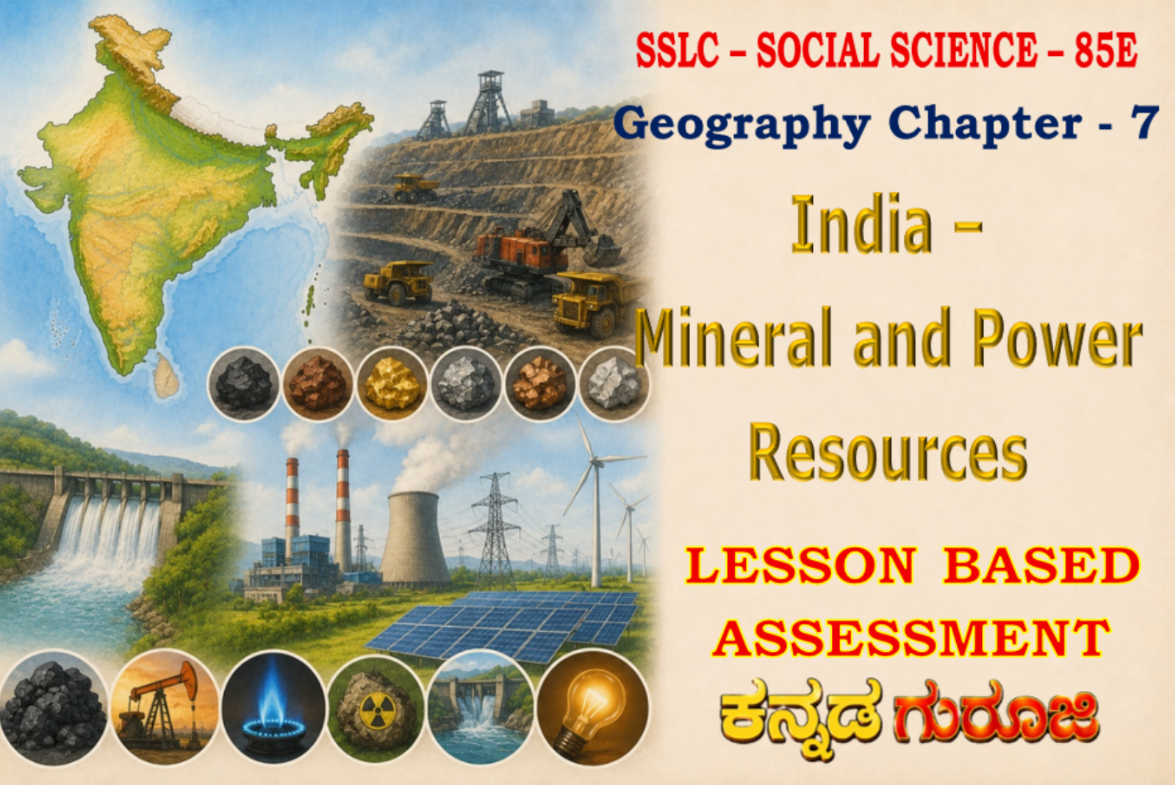
India – Mineral and Power Resources
Minerals and power resources are the foundation of modern economic development. Industries, transportation, agriculture, communication, and daily life depend heavily on minerals and energy resources. India is rich in various mineral resources and possesses both conventional and non-conventional sources of energy.
With increasing population and industrialization, the demand for minerals and power resources is growing rapidly. Therefore, proper utilization and conservation of these resources are essential for sustainable development.
This chapter explains the distribution, production, uses, and conservation of mineral and power resources in India.
What are Minerals?
Minerals are naturally occurring inorganic substances found in the earth’s crust with definite chemical composition and physical properties.
Importance of Minerals
- Provide raw materials for industries
- Support economic development
- Generate employment
- Promote industrial growth
- Contribute to national income
Classification of Minerals
Minerals are broadly classified into:
1. Metallic Minerals
These minerals contain metals and can be extracted for industrial use.
Examples
- Iron ore
- Manganese
- Copper
- Gold
- Bauxite
2. Non-Metallic Minerals
These minerals do not contain metals.
Examples
- Mica
- Limestone
- Gypsum
3. Atomic Minerals
Used for generating nuclear energy.
Examples
- Uranium
- Thorium
Iron Ore
Iron ore is the backbone of modern industries.
Importance
- Basic raw material for steel industry
- Used in engineering industries
- Supports infrastructure development
Major Iron Ore Producing States
- Odisha
- Chhattisgarh
- Karnataka
- Jharkhand
- Goa
Types of Iron Ore
- Magnetite
- Hematite
- Limonite
- Siderite
Manganese
Manganese is an important metallic mineral.
Types of Manganese Ore
- Pyrolusite
- Psilomelane
- Manganite
- Braunite
Uses of Manganese
- Steel manufacturing
- Production of alloys
- Dry cell batteries
- Glass industry
- Chemical industry
Why is Manganese Considered a Multipurpose Mineral?
Because it is used in steel production, batteries, chemicals, and several industries.
Bauxite
Bauxite is the principal ore of aluminium.
Why is Aluminium Called the Wonder Metal of the 20th Century?
Because it is:
- Light in weight
- Strong
- Corrosion resistant
- Good conductor of electricity
- Widely used in modern industries
Major Bauxite Producing States
- Odisha
- Gujarat
- Maharashtra
- Jharkhand
- Chhattisgarh
Gold
Gold is one of the most valuable precious metals.
Metal Used as an International Measure of Value
Gold is widely used as a standard of international value determination.
Major Gold Producing Mine in India
Hutti Gold Mines (Karnataka) produces the highest amount of gold in India.
Uses of Gold
- Jewellery
- Banking reserves
- Electronics
- Medical applications
Mica
Mica is an important non-metallic mineral.
Why is Mica Called "Kage Bangara" (Crow Gold)?
Because of its shiny appearance and economic importance.
Uses of Mica
- Electrical industry
- Electronic equipment
- Insulation materials
- Paint industry
- Cosmetics
Why Has the Export of Mica Reduced Today?
Due to the availability of synthetic substitutes and changing industrial requirements.
Coal
Coal is the most important conventional source of energy in India.
Uses of Coal
- Thermal power generation
- Steel industry
- Cement industry
- Chemical industry
- Domestic fuel
Importance
Coal contributes significantly to India's power generation and industrial development.
Petroleum
Petroleum is the most important liquid fuel resource.
Why is Petroleum Called Liquid Gold?
Because it is a highly valuable multipurpose energy resource.
India's Largest Petroleum Deposit
Bombay High is the largest petroleum deposit in India.
First Petroleum Discovery in India
Petroleum was first discovered at Digboi in Assam.
Uses of Petroleum
- Transportation fuel
- Industrial fuel
- Petrochemical industry
- Fertilizer production
- Lubricants
Natural Gas
Natural gas is an important clean energy resource.
Advantages
- Environment-friendly
- High efficiency
- Less pollution
- Used in industries and households
Major Production Areas
- Mumbai High
- Krishna-Godavari Basin
- Assam
- Gujarat
Atomic Minerals and Nuclear Energy
Atomic minerals are used for nuclear power generation.
Important Atomic Minerals
- Uranium
- Thorium
Mineral Used as Moderator in Nuclear Reactors
Graphite is used as a moderator in certain nuclear reactors.
Nuclear Power Stations in India
- Kaiga
- Narora
- Tarapur
- Kalpakkam
Advantages
- Large energy production
- Low carbon emissions
- Efficient energy source
Power Resources
Power resources are classified into:
Conventional Energy Sources
Traditional sources of energy that have been used for a long time.
Examples
- Coal
- Petroleum
- Natural Gas
- Hydroelectric Power
Non-Conventional Energy Sources
Modern renewable energy sources.
Examples
- Solar Energy
- Wind Energy
- Geothermal Energy
- Tidal Energy
- Biogas
Solar Energy
Solar energy is the energy obtained from the sun.
Advantages
- Renewable
- Pollution-free
- Abundant source
- Reduces dependence on fossil fuels
First Solar Power Generation Station in India
The first solar power station was established in Gujarat.
Important Solar Power Project in Karnataka
Pavagada Solar Park in Tumakuru district is one of the largest solar power projects in India.
Wind Energy
Wind energy is generated using the force of moving air.
Advantages
- Renewable
- Environment-friendly
- Cost-effective in the long run
Major Wind Energy Producing States
- Tamil Nadu
- Gujarat
- Karnataka
- Maharashtra
Global Warming
Global warming refers to the gradual increase in the average temperature of the earth due to the accumulation of greenhouse gases.
Causes
- Burning of fossil fuels
- Deforestation
- Industrial emissions
- Excessive use of energy resources
Effects
- Climate change
- Melting glaciers
- Rising sea levels
- Extreme weather events
Why is the Use of Non-Conventional Energy Resources Essential?
- Conventional energy resources are limited.
- Fossil fuels cause pollution.
- Renewable sources are sustainable.
- Helps reduce global warming.
- Ensures future energy security.
Conservation of Energy Resources
Methods
- Use energy efficiently
- Reduce wastage
- Promote renewable energy
- Encourage public awareness
- Improve technology
- Adopt sustainable practices
Suggestions to Overcome Energy Scarcity
- Increase solar power generation
- Expand wind energy projects
- Promote energy conservation
- Develop alternative fuels
- Improve public transport
- Encourage scientific management of resources
Important Questions for LBA Preparation
1 Mark Questions
✔ Why is petroleum called liquid gold?
✔ What is solar energy?
✔ What is global warming?
✔ Where was petroleum first discovered in India?
✔ Which mineral is used as a moderator in nuclear reactors?
✔ Why has mica export reduced today?
✔ Which is India's largest oil deposit?
✔ Which is the important solar project in Tumakuru district?
2–3 Mark Questions
Mention the uses of coal.
Coal is used for thermal power generation, steel production, cement manufacturing, and industrial fuel.
Mention the types of manganese ore.
Pyrolusite, Psilomelane, Manganite, and Braunite.
Why is the use of non-conventional energy resources essential?
Because conventional energy resources are exhaustible and renewable sources are environmentally friendly.
Why is manganese called a multipurpose mineral?
Because it is used in steel, batteries, chemicals, and glass industries.
Long Answer Questions
✔ What are the uses of mica?
✔ Give suggestions to overcome the scarcity of energy resources.
✔ Explain the importance of mineral resources in India.
✔ Differentiate between conventional and non-conventional energy resources.
✔ Explain the uses of petroleum and coal.
Conclusion
“India – Mineral and Power Resources” explains the importance of minerals, conventional and non-conventional energy resources, and their role in economic development. Conservation and efficient utilization of these resources are essential for sustainable growth and energy security.
This chapter is very important for LBA preparation and board examinations.
