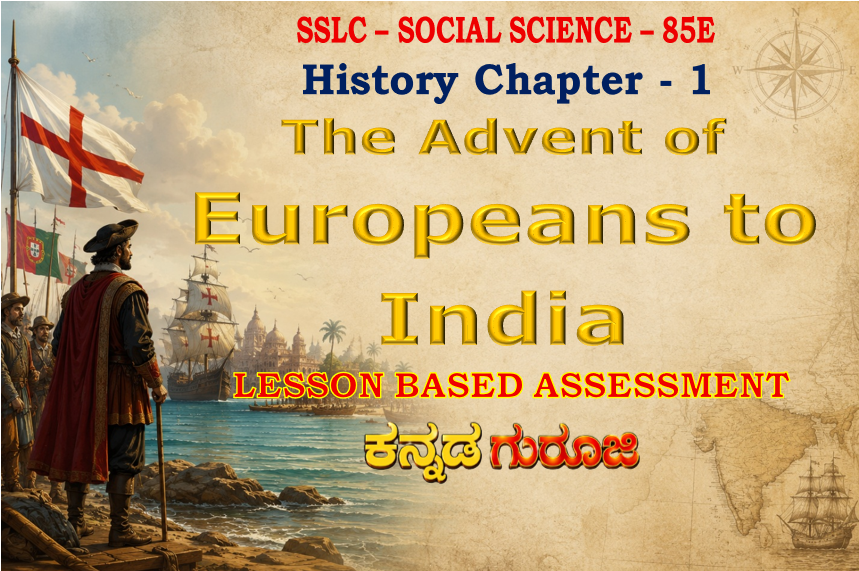
The Advent of Europeans to India
India had trade relations with many countries from ancient times because of its rich resources, spices, textiles, and strategic location. European countries came to India mainly for trade, but later their commercial interests gradually turned into political control. The arrival of Europeans changed the political and economic history of India. This chapter explains the arrival of Europeans, their rivalry, Carnatic Wars, Battle of Plassey, Battle of Buxar, and the Dual Government system.
Trade Relations Between India and Europe
India maintained strong trade relations with Europe through land and sea routes. Constantinople acted as an important gateway for European trade.
In 1453, the Turks captured Constantinople, creating difficulties in traditional trade routes. This forced Europeans to search for a new sea route to India.
Arrival of Europeans in India
Several European powers came to India for trade:
Portuguese
The Portuguese were the first Europeans to arrive in India.
- Vasco da Gama discovered the sea route to India and landed at Calicut in 1498.
- Francisco de Almeida introduced the Blue Water Policy.
- Alfonso de Albuquerque is considered the real founder of the Portuguese Empire in India.
Dutch
The Dutch established trading centers in India and expanded their commercial activities. However, their power declined after conflicts with Indian rulers.
Marthanda Varma, ruler of Travancore, controlled the Dutch influence through military strength.
French
The French established their capital at Pondicherry, which became their main center in India.
British
The British gradually expanded their trade and political power.
The Mughal Emperor Farooq Siyar permitted the British to trade freely in Bengal.
Carnatic Wars
Political rivalry between the British and French led to the Carnatic Wars.
First Carnatic War
The First Carnatic War ended with the Treaty of Aix-la-Chapelle.
Second Carnatic War
The Second Carnatic War strengthened British influence and weakened the French position in India.
Third Carnatic War
The Third Carnatic War ended through a treaty and marked the decline of French political power in India.
Battle of Plassey (1757)
The Battle of Plassey was fought between the British and Siraj-ud-Daulah.
Causes:
- Political conflicts
- British interference
- Expansion of British influence
Consequences:
- British gained political control in Bengal
- Beginning of British dominance in India
Battle of Buxar (1764)
The Battle of Buxar played a major role in British expansion in India.
Consequences:
- British gained stronger control over Bengal
- Increased political authority of the British East India Company
Dual Government System
The Dual Government System was introduced in Bengal by Robert Clive.
Under this system:
- British controlled revenue administration
- Nawab handled civil administration
This system later caused administrative problems and weakened Bengal governance.
Important Questions for LBA Preparation
1 Mark Questions
✔ Who discovered the sea route to India?
✔ Who introduced the Blue Water Policy?
✔ Which treaty ended the First Carnatic War?
✔ Which Mughal emperor permitted British trade in Bengal?
2–3 Mark Questions
✔ Explain the discovery of the sea route to India.
✔ Explain the Dual Government system.
✔ Explain the Second Carnatic War.
✔ State the causes of the Battle of Buxar.
Long Answer Questions
✔ Causes and consequences of the Battle of Plassey
✔ Consequences of the Battle of Buxar
✔ Marthanda Varma’s struggle against the Dutch
