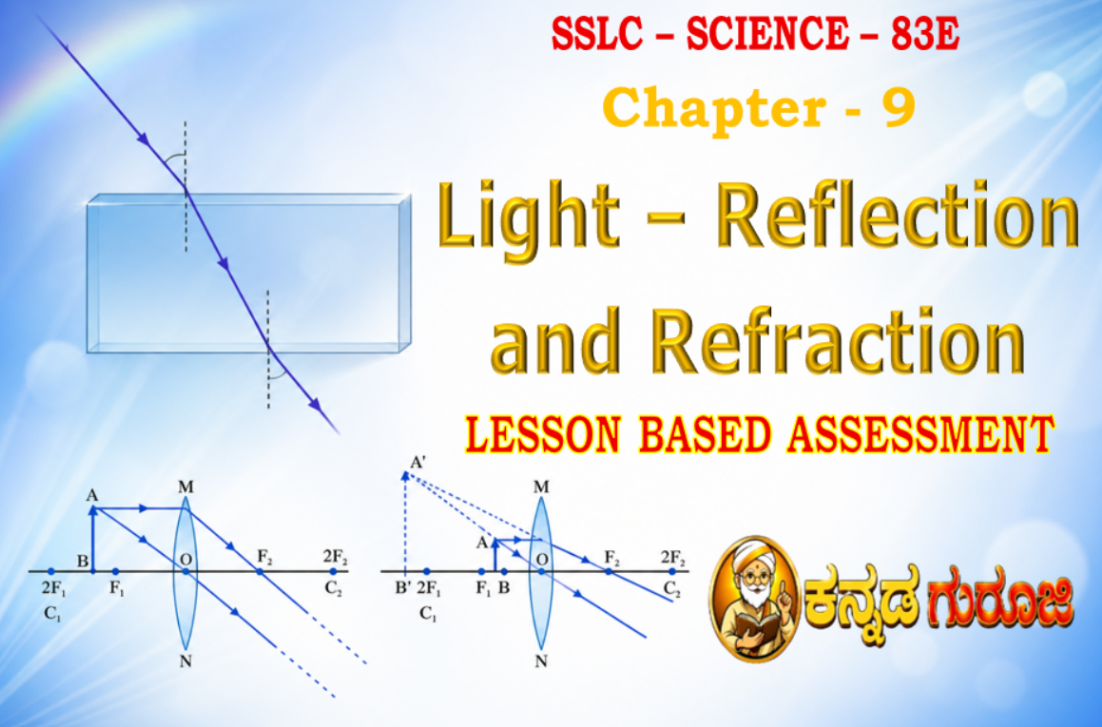
“Light – Reflection and Refraction” is one of the important chapters in SSLC Science. This chapter explains reflection of light, spherical mirrors, refraction of light, spherical lenses, image formation, lens formula, magnification and power of lenses. This article is prepared based on the uploaded English LBA document.
Learning Points
This chapter mainly includes:
- Reflection of light
- Spherical mirrors
- Reflection by spherical mirrors
- Ray diagrams of image formation by mirrors
- Reflection formula and magnification
- Refraction of light
- Refraction through rectangular glass slab
- Laws of refraction and refractive index
- Refraction by spherical lenses
- Image formation by lenses
- Lens formula and magnification
- Power of lens
These learning points are listed in the LBA document.
Reflection of Light
The bouncing back of light into the same medium after striking a surface is called Reflection of Light.
Examples:
- Reflection by mirrors
- Reflection from water surface
- Reflection from polished metals
Laws of Reflection
There are two laws of reflection:
First Law
The incident ray, reflected ray and normal lie on the same plane.
Second Law
Angle of incidence is equal to angle of reflection.
$$\angle i = \angle r$$
These laws explain the reflection of light by mirrors.
Spherical Mirrors
Mirrors having curved reflecting surfaces are called Spherical Mirrors.
Types of Spherical Mirrors
Concave Mirror
Reflecting surface curves inward.
Uses:
- Shaving mirrors
- Dentist mirrors
- Headlights and torches
Convex Mirror
Reflecting surface curves outward.
Uses:
- Rear-view mirrors of vehicles
Convex mirrors provide a wider field of view.
Important Terms of Spherical Mirrors
Pole (P)
Centre point of reflecting surface.
Centre of Curvature (C)
Centre of the sphere from which the mirror is formed.
Principal Focus (F)
Point where reflected rays meet or appear to meet.
Radius of Curvature (R)
Distance between pole and centre of curvature.
Relation:
R = 2f
Image Formation by Concave Mirror
Object Beyond C
Image formed:
- Between C and F
- Real
- Inverted
- Diminished
Object at C
Image formed:
- At C
- Real
- Inverted
- Same size
Object Between C and F
Image formed:
- Beyond C
- Real
- Inverted
- Enlarged
Object at F
Image formed:
- At infinity
- Real
- Highly enlarged
Object Between F and P
Image formed:
- Behind mirror
- Virtual
- Erect
- Enlarged
These cases are repeatedly asked in examinations.
Mirror Formula
Relation between object distance, image distance and focal length:
$$\frac{1}{f} = \frac{1}{v} + \frac{1}{u}$$
Where:
- f = focal length
- u = object distance
- v = image distance
Magnification of Mirror
Magnification is the ratio of image height to object height.
$$m = \frac{h_i}{h_o} = \frac{-v}{u}$$
Positive magnification → Virtual image
Negative magnification → Real image
Refraction of Light
The bending of light when it passes from one medium to another is called Refraction of Light.
Examples:
- Pencil appears bent in water
- Coin appears raised in water
Laws of Refraction (Snell’s Law)
First Law
Incident ray, refracted ray and normal lie in the same plane.
Second Law
$$\frac{sin(i)}{sin(r)} = n$$
Where n is a refractive index.
Refractive Index
Refractive index indicates optical density of medium.
Formula:
$$n = \frac{c}{v}$$
Where:
- c = speed of light in vacuum
- v = speed of light in medium
Higher refractive index → lower speed of light.
Spherical Lenses
Lenses are transparent materials bounded by curved surfaces.
Convex Lens
- Thick at middle
- Thin at edges
- Converges light rays
Concave Lens
- Thin at middle
- Thick at edges
- Diverges light rays
Image Formation by Convex Lens
Object Beyond 2F₁
Image:
- Between F₂ and 2F₂
- Real
- Inverted
- Diminished
Object at 2F₁
Image:
- At 2F₂
- Real
- Inverted
- Same size
Object Between F₁ and 2F₁
Image:
- Beyond 2F₂
- Real
- Inverted
- Enlarged
Object Between F₁ and O
Image:
- On same side of lens
- Virtual
- Erect
- Enlarged
Lens Formula
Relation among focal length, image distance and object distance:
$$\frac{1}{f} = \frac{1}{v} - \frac{1}{u}$$
Magnification by Lens
$$m = \frac{h_i}{h_o} = \frac{v}{u}$$
Power of Lens
Power of lens indicates ability of lens to converge or diverge light.
Formula:
$$P = \frac{1}{f}$$
SI unit:
Dioptre (D)
Examples:
- Convex lens → Positive power
- Concave lens → Negative power
Important Exam Questions
One Mark Questions
- What is reflection of light?
- Define refractive index.
- What is aperture?
- Define principal focus.
Two Mark Questions
- State laws of reflection.
- Differentiate convex and concave lenses.
- Explain refraction of light.
Three and Four Mark Questions
- Explain image formation by concave mirror.
- Explain refraction through a glass slab.
- Derive mirror formula.
- Explain activity to find focal length of concave mirror.
These questions are repeatedly asked in examinations.
Preparation Tips for Students
- Practice all ray diagrams regularly
- Learn mirror and lens formulas
- Study image formation cases carefully
- Revise refractive index and laws of refraction
- Practice numerical problems on power and magnification
Conclusion
“Light – Reflection and Refraction” is an important scoring chapter in SSLC Science. Understanding mirrors, lenses, refraction and image formation helps students score better marks in examinations.
