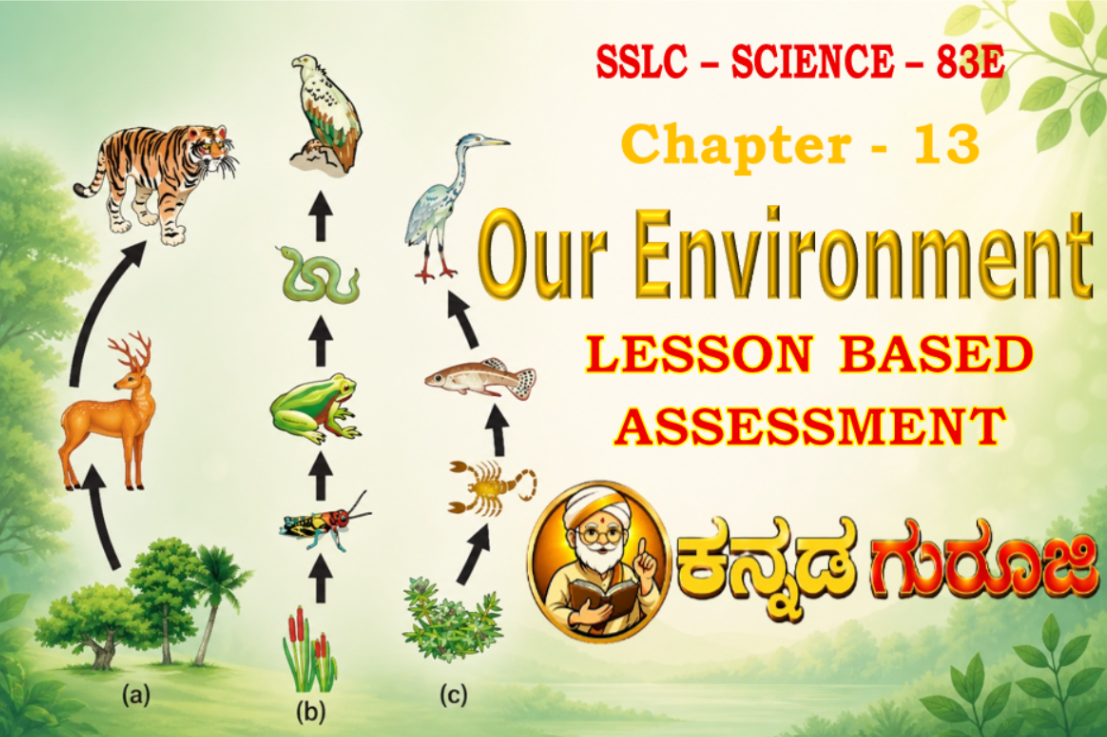
“Our Environment” is one of the important chapters in SSLC Science. This chapter explains ecosystem, food chains, food webs, environmental issues, ozone layer depletion and waste management. It also explains how human activities affect the environment and the importance of protecting ecosystems. This article is prepared based on the uploaded English LBA document.
Learning Points
This chapter mainly includes:
- Ecosystem – its components
- Food chains and food webs
- Effects of human activities on environment
- Ozone layer and its depletion
- Waste management
These learning points are mentioned in the LBA document.
Environment
Everything surrounding living organisms including physical, biological and social factors is called the Environment.
Environment includes:
- Living components
- Non-living components
Ecosystem
A system formed by interaction between living organisms and their surroundings is called an Ecosystem.
Examples:
- Forest ecosystem
- Grassland ecosystem
- Aquatic ecosystem
Components of Ecosystem
Ecosystem has two main components:
Biotic Components (Living)
These include living organisms.
Examples:
- Plants
- Animals
- Microorganisms
Types of Biotic Components
Producers
Organisms that prepare their own food.
Examples:
- Green plants
- Algae
Producers occupy the first trophic level.
Consumers
Organisms depend on others for food.
Examples:
- Herbivores
- Carnivores
Types:
- Primary consumers
- Secondary consumers
- Tertiary consumers
Primary consumers are always herbivores.
Decomposers
Organisms that break down dead plants and animals into simpler substances are called Decomposers.
Examples:
- Bacteria
- Fungi
Functions:
- Recycle nutrients
- Clean environment
- Maintain ecosystem balance
Abiotic Components (Non-Living)
Examples:
- Air
- Water
- Soil
- Sunlight
- Temperature
These factors support life in the ecosystem.
Food Chain
The sequence of organisms through which food and energy pass is called a Food Chain.
Example:
Grass → Grasshopper → Frog → Snake → Eagle
This represents transfer of energy from one trophic level to another.
Trophic Levels
Each step in a food chain is called a Trophic Level.
First Trophic Level
Producers
Second Trophic Level
Primary consumers (Herbivores)
Third Trophic Level
Secondary consumers
Fourth Trophic Level
Tertiary consumers
The second trophic level always contains herbivores.
Flow of Energy in Ecosystem
Energy flow in the ecosystem is unidirectional.
Energy moves:
Sun → Producers → Consumers → Decomposers
Energy never returns to previous trophic levels.
10% Law
According to the 10% law, only 10% of energy is transferred to the next trophic level.
Example:
If producers have 5000 J energy:
Grass → Grasshopper → Frog → Snake
Energy at snake level:
5000 → 500 → 50 → 5 J
Thus the snake receives 5 J energy.
Food Web
The interconnection of several food chains is called Food Web.
Food web:
- Maintains ecosystem stability
- Provides alternative food sources
- Increases survival chances
Biological Magnification (Biomagnification)
Increase in concentration of harmful chemicals at successive trophic levels is called Biological Magnification.
Example:
Water → Algae → Fish → Birds
Highest accumulation occurs at higher trophic levels.
Biodegradable Substances
Substances that decompose naturally by microorganisms are called Biodegradable Substances.
Examples:
- Fruit peels
- Leaves
- Paper
- Vegetable waste
These substances recycle naturally in the environment.
Non-Biodegradable Substances
Substances that do not decompose naturally are called Non-biodegradable Substances.
Examples:
- Plastic
- Glass
- Metals
Effects:
- Environmental pollution
- Biomagnification
- Harm to organisms
Ozone Layer
Ozone layer contains O₃ molecules and is present in the atmosphere.
It absorbs harmful ultraviolet rays from the sun and protects life on Earth.
Ozone Layer Depletion
Ozone depletion occurs due to chemicals such as Chlorofluorocarbons (CFCs).
Sources:
- Refrigerators
- Air conditioners
- Aerosol sprays
Because of ozone depletion:
- Skin cancer increases
- Eye damage occurs
- Harmful UV rays reach Earth
Therefore CFC-free refrigerators are used.
Waste Management
Waste management means proper collection, treatment and disposal of waste.
Methods:
- Reduce
- Reuse
- Recycle
Importance:
- Reduces pollution
- Protects environment
- Conserves resources
Eco-Friendly Practices
Examples:
- Carry cloth bags while shopping
- Switch off unnecessary lights and fans
- Walk instead of using vehicles for short distances
These practices reduce environmental pollution.
Important Exam Questions
One Mark Questions
- What is the ecosystem?
- Define the food chain.
- What is biomagnification?
- State 10% law.
Two Mark Questions
- Differentiate biodegradable and non-biodegradable substances.
- Explain role of decomposers.
- Explain ozone layer depletion.
Three Mark Questions
- Explain flow of energy in the ecosystem.
- Explain food chain and trophic levels.
- Explain biological magnification.
Four Mark Questions
- Explain the ecosystem and its components.
- Explain effects of non-biodegradable substances.
- Explain ozone depletion and protection measures.
These questions are repeatedly asked in examinations.
Preparation Tips for Students
- Learn food chains and trophic levels carefully
- Practice energy flow problems using 10% law
- Study biodegradable and non-biodegradable substances
- Revise biomagnification and ozone depletion
- Learn eco-friendly practices and waste management methods
Conclusion
“Our Environment” is an important scoring chapter in SSLC Science. Understanding ecosystems, food chains, biomagnification and environmental protection helps students score better marks in examinations.
