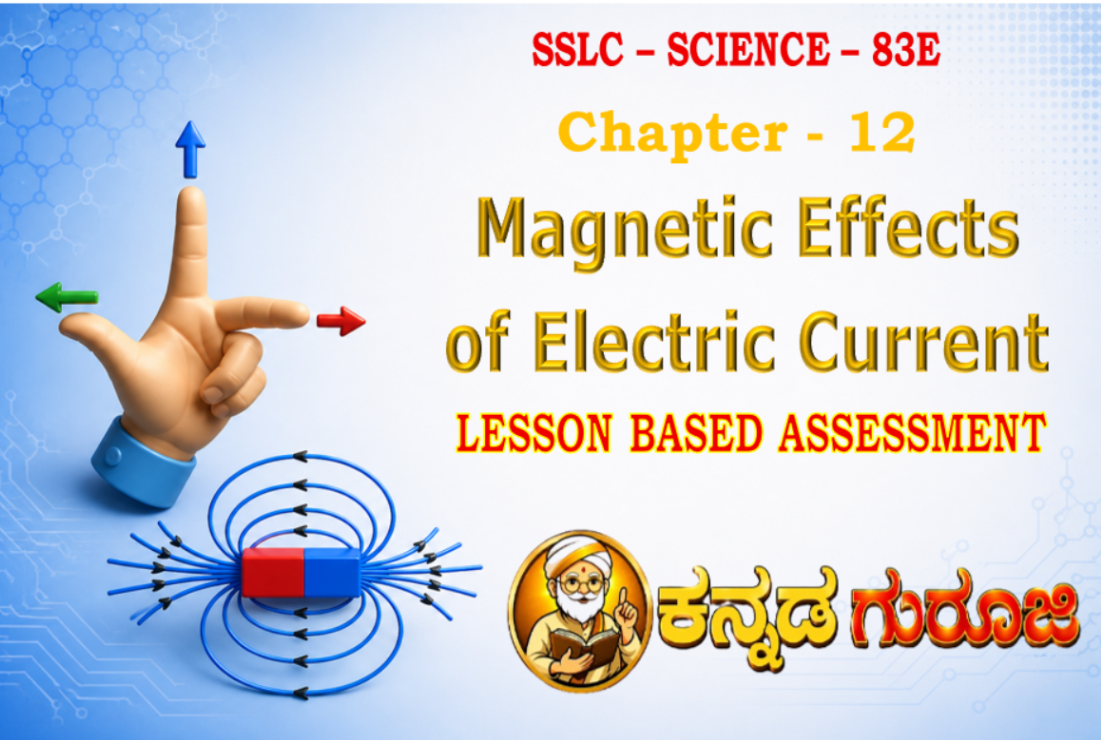
“Magnetic Effects of Electric Current” is one of the important chapters in SSLC Science. This chapter explains magnetic fields, magnetic lines of force, magnetic field due to current carrying conductors, right-hand thumb rule, magnetic field in solenoids, force on current carrying conductors and household electrical circuits. This article is prepared based on the uploaded English LBA document.
Learning Points
This chapter mainly includes:
- Magnetic field and magnetic lines of force
- Magnetic field due to a current carrying conductor
- Magnetic field due to current flowing in a straight conductor
- Right-hand thumb rule
- Magnetic field due to current in a circular conductor
- Magnetic field due to current in a solenoid
- Force on a current carrying conductor in a magnetic field
- Household electrical circuits
Magnetic Field
The region around a magnet where its magnetic effect can be experienced is called a Magnetic Field.
A magnetic field can be represented using magnetic lines of force.
Magnetic Lines of Force
The imaginary lines representing the magnetic field are called Magnetic Lines of Force.
Characteristics of Magnetic Lines of Force
- Magnetic lines emerge from the North pole and merge at the South pole outside the magnet.
- Inside the magnet, they move from the South pole to North pole, forming closed loops.
- No two magnetic lines intersect each other.
- The magnetic field is stronger where magnetic lines are closer together.
Magnetic Field Due to Current Carrying Conductor
When electric current flows through a conductor, a magnetic field is produced around it.
This was first observed by Hans Christian Oersted.
A compass needle gets deflected when brought near a current carrying conductor.
Magnetic Field Around a Straight Conductor
The magnetic field lines around a straight current carrying conductor are concentric circles.
The conductor acts as the centre of magnetic field lines.
Factors affecting magnetic field strength:
- Amount of current
- Distance from conductor
More current produces stronger magnetic fields.
Right-Hand Thumb Rule
The direction of the magnetic field around a straight conductor is determined using the Right-Hand Thumb Rule.
Rule:
If the conductor is held in the right hand such that the thumb points in the direction of current, then the curled fingers indicate the direction of magnetic field lines.
Magnetic Field Due to Circular Loop
A current carrying a circular loop also produces a magnetic field.
Magnetic field strength increases when:
- Current increases
- Number of turns increases
- Radius decreases
If the number of turns increases 10 times, the magnetic field also increases 10 times.
Solenoid
A long cylindrical coil having many circular turns of insulated copper wire is called a Solenoid.
Inside a solenoid:
- Magnetic field lines are parallel
- Magnetic field is uniform at every point
The magnetic field inside solenoid resembles that of a bar magnet.
Electromagnet
A solenoid can be converted into an electromagnet by inserting a soft iron core inside it.
Applications:
- Electric bell
- Cranes
- Relays
- Motors
Force on a Current Carrying Conductor in Magnetic Field
A current carrying conductor experiences force when placed in a magnetic field.
Maximum force occurs when conductor is placed at:
90°
The direction of force is determined using Fleming’s Left-Hand Rule.
Fleming’s Left-Hand Rule
Stretch the thumb, forefinger and middle finger of the left hand mutually perpendicular.
- Forefinger → Magnetic field
- Middle finger → Electric current
- Thumb → Motion / Force on conductor
Household Electrical Circuits
Household electrical circuits include:
- Live wire
- Neutral wire
- Earth wire
Domestic appliances are generally connected in parallel combinations.
Advantages:
- Same voltage across appliances
- Independent operation of appliances
Earthing
Earthing is a safety method used to protect users from electric shock.
Functions:
- Transfers leakage current to earth
- Protects electrical appliances
- Prevents electric shock
Metal-bodied appliances are connected to earth wire for safety.
Overloading
Overloading occurs when current exceeds the safe limit in a circuit.
Causes:
- Connecting many appliances simultaneously
- Short circuit
- Faulty wiring
Effects:
- Excess heating
- Fire hazards
- Damage to appliances
Fuse
Fuse is a safety device used to prevent damage due to overload.
Functions:
- Breaks circuit during excessive current
- Protects appliances from damage
Fuse wire has:
- Low melting point
- High resistivity
Short Circuit
Short circuit occurs when live and neutral wires come into direct contact.
Effect:
Current becomes very high and causes heating.
Important Exam Questions
One Mark Questions
- What is magnetic field?
- Define solenoid.
- State right-hand thumb rule.
- What is earthing?
Two Mark Questions
- Write characteristics of magnetic lines of force.
- Explain causes of overload.
- Explain solenoid and electromagnet.
Three Mark Questions
- Explain the right-hand thumb rule.
- Explain Fleming’s left-hand rule.
- Explain the earthing system.
Four Mark Questions
- Explain experiment showing force on current carrying conductor in magnetic field.
- Explain household electrical circuits.
- Explain magnetic field around straight conductor.
These questions are repeatedly asked in examinations.
Preparation Tips for Students
- Learn right-hand thumb rule and Fleming’s left-hand rule
- Practice diagrams of magnetic field lines
- Study solenoid and electromagnet carefully
- Revise earthing and fuse concepts
- Practice household circuit diagrams regularly
Conclusion
“Magnetic Effects of Electric Current” is an important scoring chapter in SSLC Science. Understanding magnetic fields, solenoids, electromagnets and household circuits helps students score better marks in examinations.
