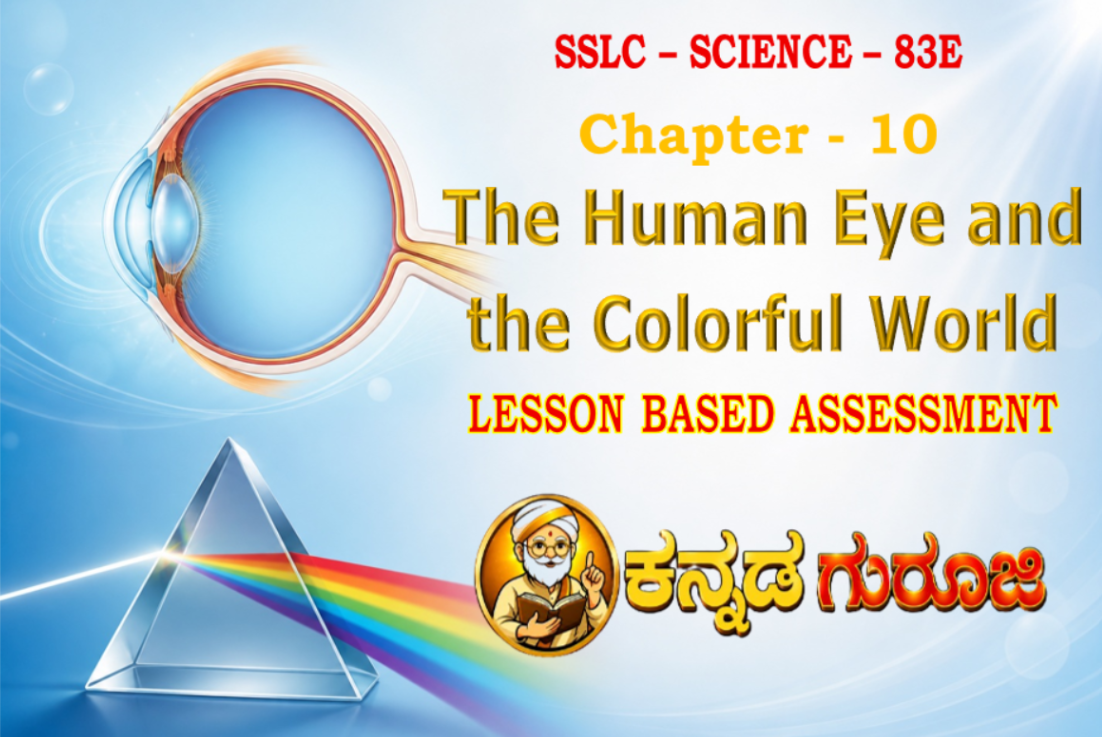
“Human Eye and Colourful World” is one of the important chapters in SSLC Science. This chapter explains the structure and functioning of the human eye, defects of vision and their correction, atmospheric refraction, scattering of light, dispersion and related natural phenomena. This article is prepared based on the uploaded English LBA document.
Learning Points
This chapter mainly includes:
- Human eye and its structure
- Accommodation of eye
- Defects of vision and correction
- Refraction of light through atmosphere
- Atmospheric refraction
- Dispersion of light
- Scattering of light
- Tyndall effect
- Colour of sky and sunrise/sunset phenomena
The chapter covers concepts related to human vision and optical phenomena.
Human Eye
The human eye is a natural optical instrument that helps us to see objects.
Main parts of human eye:
- Cornea
- Iris
- Pupil
- Eye lens
- Retina
- Ciliary muscles
- Optic nerve
The image is formed on the retina. The eye lens forms a real and inverted image on the retina.
Important Parts and Functions
Cornea
- Transparent bulged surface of eyeball
- Refracts most of the incoming light
Iris
- Dark muscular diaphragm
- Controls size of pupil
Pupil
- Controls amount of light entering eye
Retina
- Light sensitive screen where image is formed
Ciliary Muscles
- Change focal length of eye lens
- Help accommodation of eye
Accommodation of Eye
The ability of eye lens to adjust focal length for viewing near and distant objects is called Accommodation of Eye.
Viewing Distant Objects
- Ciliary muscles relax
- Focal length increases
- Eye lens becomes thinner
Viewing Near Objects
- Ciliary muscles contract
- Focal length decreases
- Eye lens becomes thicker
Near Point and Far Point
Near Point
The nearest point up to which the eye can see clearly.
For normal eye:
25 cm
Far Point
The farthest point visible clearly.
For normal eye:
Infinity
Defects of Vision
Myopia (Near Sightedness)
A person can see nearby objects clearly but distant objects appear blurred.
Causes
- Elongation of eyeball
- Excessive curvature of eye lens
Correction
Using concave lens
The correcting lens has negative power.
Hypermetropia (Far Sightedness)
A person sees distant objects clearly but near objects appear blurred.
Causes
- Short eyeball
- Large focal length of eye lens
Correction
Using convex lens
Presbyopia
Defect caused due to ageing.
Causes
- Weak ciliary muscles
- Reduced flexibility of eye lens
Correction
Using bifocal lenses.
Cataract
In old age eye lenses sometimes become cloudy and milky white.
This condition is called Cataract. It can be corrected by surgery.
Atmospheric Refraction
Refraction caused due to the atmosphere is called Atmospheric Refraction.
Examples:
- Twinkling of stars
- Early sunrise
- Delayed sunset
Sun appears about two minutes before actual sunrise and remains visible about two minutes after sunset because of atmospheric refraction.
Twinkling of Stars
Stars twinkle because their light continuously refracts through different atmospheric layers.
Planets generally do not twinkle because they appear larger.
Dispersion of Light
Splitting of white light into seven colours by prism is called Dispersion of Light.
The band of colours formed is called Spectrum.
Colours:
Violet – Indigo – Blue – Green – Yellow – Orange – Red
(VIBGYOR)
Newton’s Prism Experiment
Newton passed white light through a prism.
Observation:
- White light split into seven colours
- Another prism recombined colours into white light again
This proved that white light consists of seven colours.
Rainbow Formation
Rainbow forms due to:
- Refraction of sunlight
- Dispersion of light
- Internal reflection inside water droplets
Rainbow shows seven colours.
Scattering of Light
Change in direction of light due to particles in the atmosphere is called Scattering of Light.
Small Particles
Scatter blue colour more.
Large Particles
Scatter all colours equally.
Tyndall Effect
Scattering of light by colloidal particles is called the Tyndall Effect.
Examples:
- Sunlight entering through forest
- Beam of light visible in fog
Why Does the Sky Appear Blue?
The blue colour has a shorter wavelength and scatters more.
Hence the sky appears blue.
On the moon, the sky appears black because the atmosphere is absent.
Why Does the Sky Appear Red at Sunrise and Sunset?
During sunrise and sunset sunlight travels a longer distance.
Blue light scatters away and red light reaches the observer.
Hence the sky appears red.
Important Exam Questions
One Mark Questions
- What is the nearest point?
- Define spectrum.
- What is the angle of deviation?
- What is cataract?
Two Mark Questions
- Explain hypermetropia and its causes.
- Explain myopia and correction.
- Explain rainbow formation.
Three Mark Questions
- Explain the Tyndall effect with examples.
- Why do stars twinkle?
- Explain scattering of light.
Four Mark Questions
- Explain rainbow formation and twinkling of stars.
- Explain myopia and correction.
- Explain accommodation of the eye.
These questions are repeatedly asked in examinations.
Preparation Tips for Students
- Learn structure of human eye carefully
- Practice defects of vision and corrections
- Study atmospheric refraction examples
- Learn VIBGYOR sequence
- Revise scattering and dispersion concepts regularly
Conclusion
“Human Eye and Colourful World” is an important scoring chapter in SSLC Science. Understanding the human eye, defects of vision, atmospheric refraction and scattering of light helps students score better marks in examinations.
