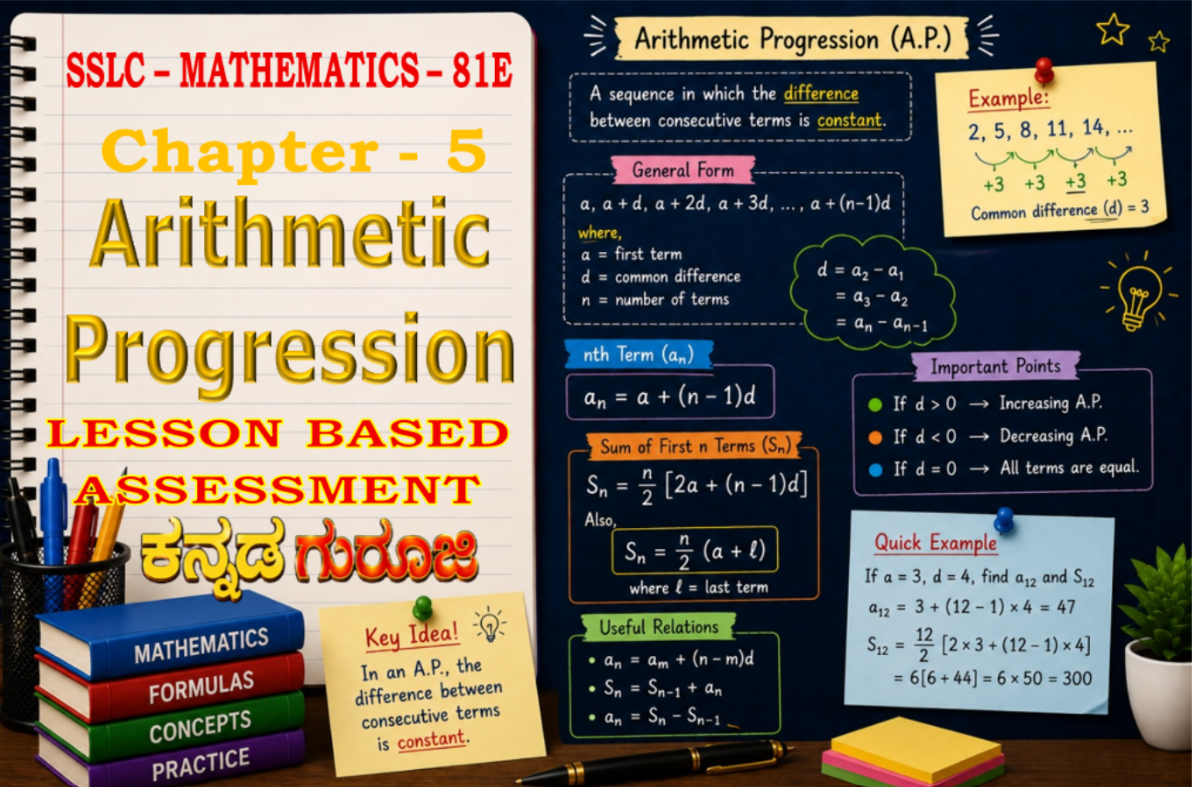
Arithmetic Progressions (A.P.) is one of the important chapters in SSLC Mathematics. This chapter helps students understand sequences, common differences, nth terms, sum of terms, and real-life application problems.
This chapter is highly scoring because direct questions, formula-based problems, sequence identification questions, and application problems are frequently asked in board examinations. The LBA material contains easy, average, and difficult level questions covering all concepts.
Learning Points in Arithmetic Progressions
Students should focus on the following concepts:
- Definition of Arithmetic Progression
- General Form of Arithmetic Progression
- nth Term of Arithmetic Progression
- Sum of n Terms of Arithmetic Progression
- Application Problems
These concepts are important for board examinations.
Important Topics to Study
1. Arithmetic Progression (A.P.)
An arithmetic progression is a sequence in which the difference between consecutive terms remains constant.
Example:
5, 9, 13, 17, …
Common Difference:
d = 4
Students should identify whether a sequence is an A.P. or not.
2. General Form of Arithmetic Progression
General form:
a, a + d, a + 2d, a + 3d,…
Where:
- a = first term
- d = common difference
This topic is frequently asked in board examinations.
3. nth Term of Arithmetic Progression
Formula:
$$a_n = a + (n - 1) d$$
Example:
A.P.:
2, 7, 12, …
Find 15th term:
a = 2, d = 5, n = 15
This formula is important for many board questions.
4. Sum of n Terms of Arithmetic Progression
Formula:
$$S_n = \frac{n}{2} [2a + (n - 1) d]$$
Alternative formula:
$$S_n = \frac{n}{2} (a + 1)$$
Where:
- a = first term
- l = last term
- n = number of terms
These formulas are frequently used in exams.
Frequently Asked Board Exam Questions
Students should practice:
- Identify Arithmetic Progression
- Find common difference
- Find nth term
- Find number of terms
- Find sum of terms
- Application problems
Important Application Problems
Board examinations frequently ask:
Number Problems
Examples:
- Consecutive numbers
- Divisibility problems
- Natural numbers
Geometry Problems
Examples:
- Polygon angles
- Triangle angles
- Quadrilateral angles
Daily Earnings Problems
Examples:
- Income growth
- Salary progression
- Daily wages
Digit Problems
Examples:
- Three-digit numbers
- Sum of digits
- Digit arrangement
Important Formula Section
General Form:
a, a + d, a + 2d,…
nth Term:
$$a_n = a + (n - 1) d$$
Sum Formula:
$$S_n = \frac{n}{2} [2a + (n - 1) d]$$
Last Term Formula:
$$S_n = \frac{n}{2} (a + 1)$$
Important 1-Mark Questions
Students should practice:
- Common difference
- First term
- nth term
- General form
- Number of terms
These questions are easy scoring.
Preparation Tips for Students
Learn All Formulas Properly
Remember:
$$a_n = a + (n - 1) d$$
$$S_n = \frac{n}{2} [2a + (n - 1) d]$$
Practice Sequence Questions Daily
Most board questions come directly from formulas.
Solve Previous Year Questions
Many questions repeat every year.
Practice Application Problems
Long-answer questions carry good marks.
Revise Common Difference Concepts
MCQ questions are frequently asked.
Why This Chapter is Important
Arithmetic Progressions chapter is important because:
- Easy scoring chapter
- Formula-based questions
- Repeated board questions
- Useful for higher mathematics
- Simple calculations
Students who master formulas can score good marks easily.
Conclusion
Arithmetic Progressions is one of the important chapters in SSLC Mathematics. Students should focus on common differences, nth term formulas, sum formulas, and application problems.
Regular practice, solving formula-based questions, and previous year questions will help students score better in examinations.
Students should practice all important questions from the LBA material carefully for better preparation and success in SSLC exams.
