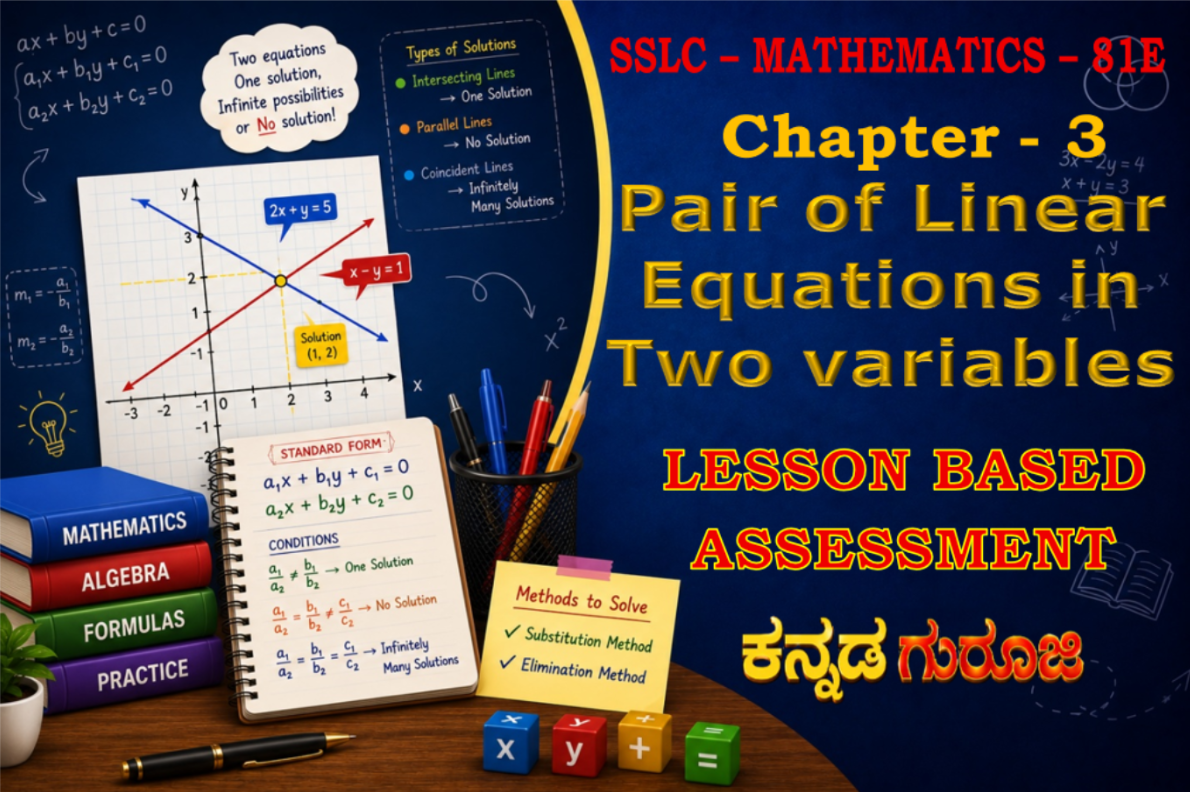
Pair of Linear Equations in Two Variables is one of the important chapters in SSLC Mathematics. This chapter helps students understand linear equations, graphical representation, algebraic methods, and real-life application problems.
Students learn how to solve equations using graphical methods, substitution methods, and elimination methods. This chapter is highly important because direct questions, graph-based problems, and application problems are frequently asked in board examinations. The LBA material contains easy, average, and difficult level questions covering all concepts.
Learning Points in Pair of Linear Equations
Students should focus on the following concepts:
- Introduction to Pair of Linear Equations in Two Variables
- Standard Form of Linear Equations
- Graphical Method of Solution
- Relationship between Ratios of Coefficients
- Algebraic Methods
- Substitution Method
- Elimination Method
- Application Problems
These concepts are very important for board exam preparation.
Important Topics to Study
1. Standard Form of Pair of Linear Equations
The standard form of pair of linear equations is:
$$ a_1 x + b_1 y + c_1 = 0$$
and
$$ a_2 x + b_2 y + c_2 = 0$$
Students should understand the coefficients and variables clearly. Questions based on standard form are commonly asked in exams.
2. Types of Solutions Based on Graphs
Intersecting Lines
If:
$$ \frac{a_1}{a_2} {\not =} \frac{b_1}{b_2}$$
The equations have one unique solution.
Parallel Lines
If:
$$ \frac{a_1}{a_2} = \frac{b_1}{b_2} {\not =} \frac{c_1}{c_2}$$
The equations have no solution.
Coincident Lines
If:
$$ \frac{a_1}{a_2} = \frac{b_1}{b_2} = \frac{c_1}{c_2}$$
The equations have infinitely many solutions.
These concepts are repeatedly asked as MCQs in board exams.
3. Elimination Method
Students solve equations by eliminating one variable.
Example:
$$2x + y = 10$$
$$x - y = 2$$
Add or subtract equations to eliminate variables and find values of x and y.
This method is frequently used in board examinations.
4. Substitution Method
Example:
$$x + y = 14$$
$$x - y = 4$$
Steps:
- Find one variable from one equation
- Substitute into another equation
- Solve the values
Students should practice substitution problems regularly.
5. Graphical Method
In graphical method:
- Draw both equations on graph paper
- Find intersection point
- Intersection gives solution
Important cases:
- Intersecting lines → One solution
- Parallel lines → No solution
- Coincident lines → Infinite solutions
Graph questions are commonly repeated in board exams.
Frequently Asked Board Exam Questions
Students should practice:
- Identify type of lines
- Number of solutions
- Standard form questions
- Elimination method problems
- Substitution method problems
- Graphical method questions
- Application problems
Important Application Problems
Board examinations frequently ask word problems based on:
Age Problems
Example:
- Present age calculations
- Future age relations
- Past age conditions
Income and Expenditure Problems
Questions involving:
- Monthly income
- Savings
- Expenditure ratio
Speed Problems
Boat and stream questions:
- Speed in still water
- Speed of stream
Fraction Problems
Questions involving numerator and denominator changes.
These problems are important for long-answer questions.
Important 1-Mark Questions
Students should practice:
- Unique solution conditions
- Coincident lines
- Parallel lines
- Number of solutions
- Standard forms
These are easy scoring questions.
Preparation Tips for Students
Practice Graph Questions Daily
Graph-based questions are frequently repeated.
Learn Solution Conditions Properly
Unique Solution:
$$ \frac{a_1}{a_2} {\not =} \frac{b_1}{b_2}$$
Infinite Solutions:
$$ \frac{a_1}{a_2} = \frac{b_1}{b_2} = \frac{c_1}{c_2}$$
No Solution:
$$ \frac{a_1}{a_2} = \frac{b_1}{b_2} {\not =} \frac{c_1}{c_2}$$
Practice Elimination Method
Most board questions come from this method.
Solve Previous Year Questions
Many questions repeat every year.
Focus on Word Problems
Application problems carry good marks.
Why This Chapter is Important
Pair of Linear Equations chapter is important because:
- Frequently asked in board exams
- Includes graph-based questions
- Contains easy scoring MCQs
- Important application problems
- Helps in higher mathematics
Students who master this chapter can score good marks easily.
Conclusion
Pair of Linear Equations in Two Variables is one of the important chapters in SSLC Mathematics. Students should focus on graphical methods, substitution methods, elimination methods, and application problems.
Regular practice, solving graphs, and previous year questions will help students achieve better marks in board examinations.
Students should practice all important questions from the LBA material carefully for better preparation and success in SSLC exams.
