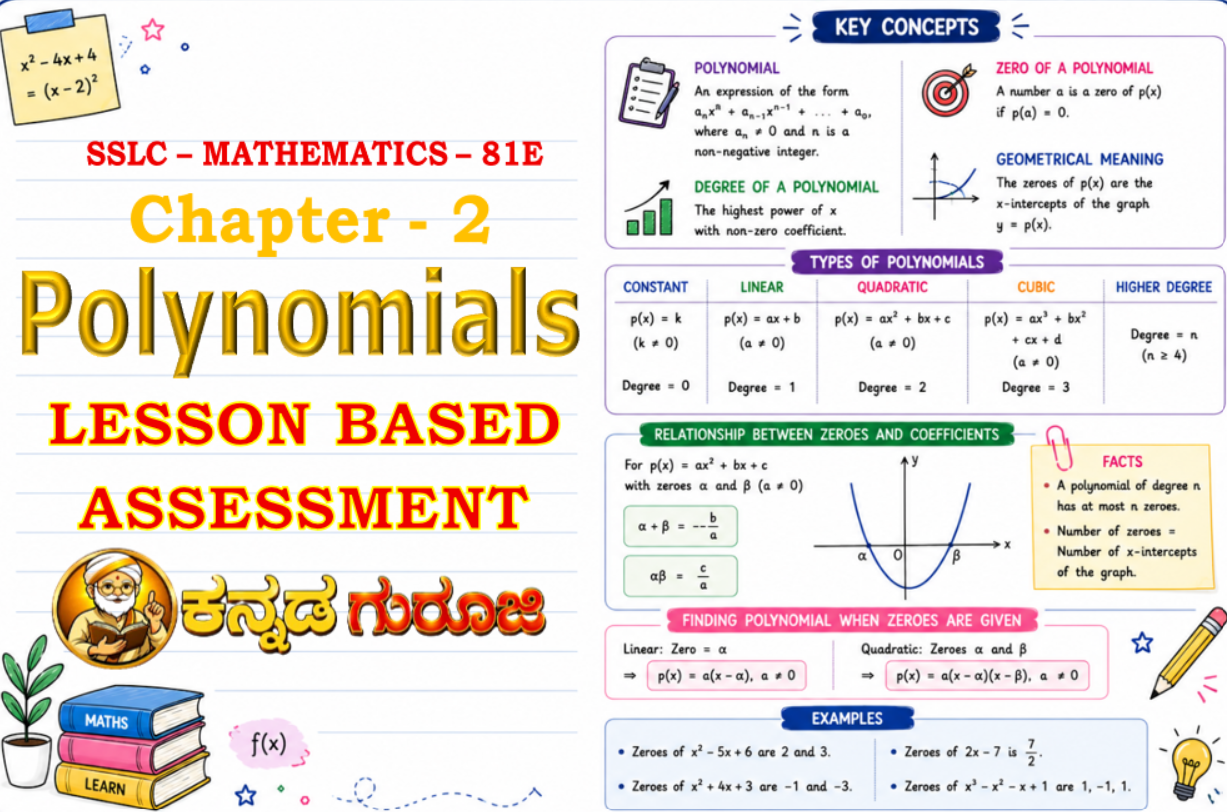
Karnataka SSLC Mathematics Chapter 2 LBA
Polynomials

Polynomials is the second chapter in SSLC Mathematics and one of the most important chapters for board examination preparation. This chapter introduces students to the degree of polynomials, types of polynomials, zeroes of polynomials, graphical representation of zeroes, and the relationship between zeroes and coefficients.
This chapter is highly scoring because many direct questions, MCQs, graph-based problems, and proof questions are repeatedly asked in board examinations. The LBA question bank includes easy, average, and difficult questions covering all important concepts.
Learning Points in Polynomials
Students should focus on the following concepts:
- Degree of a Polynomial
- Types of Polynomials
- Zeroes of a Polynomial
- Geometrical Meaning of Zeroes
- Relationship between Zeroes and Coefficients
- Finding Polynomial when Zeroes are Given
These concepts are essential for solving board exam questions efficiently.
Important Topics to Study
1. Degree of a Polynomial
The degree of a polynomial is the highest power of the variable present in the polynomial.
Examples:
Linear Polynomial:
ax + b
Degree = 1
Quadratic Polynomial:
$ax^2 + bx + c$
Degree = 2
Cubic Polynomial:
$ax^3 + bx^2 + cx + d$
Degree = 3
Questions based on degree identification are frequently asked in board exams.
2. Types of Polynomials
Linear Polynomial
Polynomial having degree 1.
Example:
2x + 5
Quadratic Polynomial
Polynomial having degree 2.
Example:
$x^2 - 4x + 5$
Cubic Polynomial
Polynomial having degree 3.
Example:
$x^3 + 2x^2 - 3x + 1$
Students should learn identification based on highest powers.
3. Zeroes of a Polynomial
Zeroes of a polynomial are the values of x for which:
p(x) = 0
Example:
For:
$x^2 - 9$
Zeroes are:
3 and –3
Many direct questions are asked on finding zeroes.
4. Graphical Representation of Zeroes
The number of times a graph intersects the x-axis gives the number of zeroes.
Important points:
- One intersection → One zero
- Two intersections → Two zeroes
- Three intersections → Three zeroes
Graph-based questions are repeatedly asked in SSLC board exams. Students should practice graphs carefully.
5. Relationship Between Zeroes and Coefficients
For quadratic polynomial:
$ax^2 + bx + c$
If zeroes are α and β:
Sum of zeroes:
$ α + β = - \dfrac{b}{a}$
Product of zeroes:
$αβ = \dfrac{c}{a}$
This topic is one of the most important sections in board exams.
Frequently Asked Board Exam Questions
Important repeated questions include:
- Find degree of polynomial
- Find number of zeroes from graph
- Find sum and product of zeroes
- Verify relationship between zeroes and coefficients
- Form polynomial using given zeroes
- Find polynomial when sum and product are given
Important 1-Mark Questions
Students should practice:
- Degree identification
- Types of polynomial
- Zeroes from graphs
- Sum of zeroes
- Product of zeroes
These questions are easy scoring and frequently repeated.
Important Graph Questions
Board exams often ask graph-based problems such as:
- Find number of zeroes from graph
- Write zeroes from graph
- Identify polynomial represented in graph
Students should understand x-axis intersections properly.
Important Difficult Questions
Students must prepare:
- Verification of relationship between coefficients and zeroes
- Finding polynomial from given roots
- Sum and product based polynomial formation
- Higher order zero relationships
Important examples:
- Sum = –3 and Product = 2
- Sum = 7 and Product = 12
- Sum = –6 and Product = 8
Preparation Tips for Students
Practice Graph Questions Daily
Graph questions are repeatedly asked in examinations.
Learn Formulas Properly
For quadratic polynomial:
$$ α + β = - \frac{b}{a}$$
$$αβ = \frac{c}{a}$$
Solve Previous Year Questions
Many board questions repeat every year.
Practice Polynomial Formation
Learn how to form polynomials using roots.
Revise Degree Concepts
Degree questions are easy to score.
Why This Chapter is Important
Polynomials chapter is important because:
- High scoring chapter
- Repeated board questions
- Includes direct MCQs
- Important for higher mathematics
- Helps in graph understanding
Students who master this chapter can score good marks easily.
