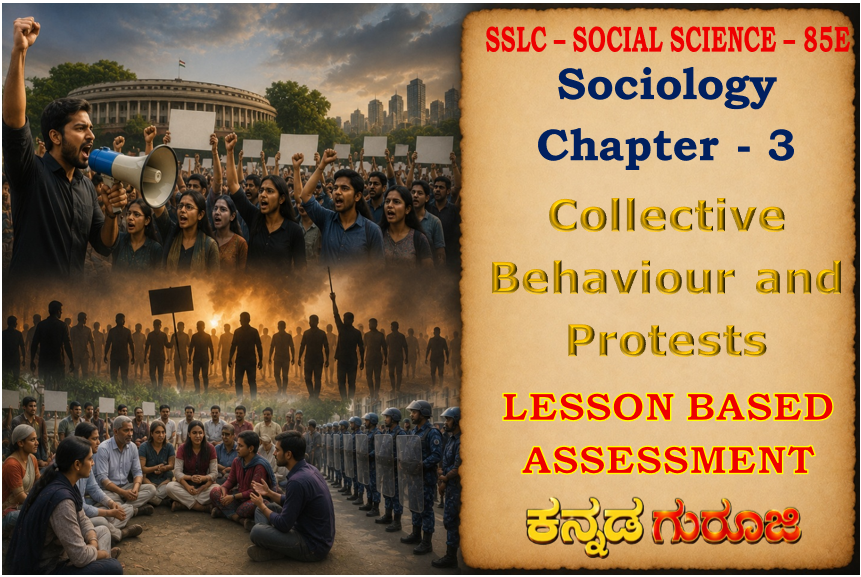
Collective Behaviour and Protests
Human beings live in groups and often act collectively to express their feelings, opinions, demands, and concerns. When a large number of people come together and act towards a common objective, it is known as collective behaviour.
Collective behaviour may be peaceful or aggressive. It can take different forms such as crowds, mobs, riots, protests, demonstrations, and social movements. Many social reforms and environmental protection efforts in India have been achieved through collective action and protest movements.
This chapter explains collective behaviour, crowds, riots, labour movements, and important environmental movements in India.
What is Collective Behaviour?
Collective behaviour refers to the actions and activities performed by a group of people in response to a common situation or issue.
Collective behaviour occurs when people gather together and act in a similar manner.
Examples of Collective Behaviour
- Public meetings
- Demonstrations
- Religious gatherings
- Protests
- Social movements
- Crowds during festivals and events
Crowd
A crowd is a temporary gathering of people at a particular place for a specific reason.
Characteristics of a Crowd
- Temporary in nature
- Large number of people
- Common focus of attention
- Emotional involvement
- Lack of formal organization
Example of a Crowd
If a person meets with an accident on the road and people gather around him, it is called a crowd.
Mob
A mob is a crowd that becomes emotionally charged and may engage in aggressive or destructive activities.
Nature of a Mob
- Highly emotional
- Uncontrolled behaviour
- Lack of rational thinking
- Possibility of violence
- Temporary existence
Effects of Mob Behaviour
- Damage to property
- Threat to public safety
- Social unrest
- Violence and conflicts
Riot
A riot is a violent disturbance caused by a group of people resulting in damage to life and property.
Riots create fear and insecurity in society.
Causes of Riots
- Religious conflicts
- Political disputes
- Social inequality
- Economic problems
- Rumours and misunderstandings
- Communal tensions
Characteristics of a Riot
- Violence and aggression
- Destruction of property
- Loss of life
- Breakdown of law and order
- Fear and insecurity among people
Why Can Uncontrolled Riots Be Dangerous?
Uncontrolled riots can:
- Destroy public and private property
- Cause injuries and deaths
- Disrupt peace and harmony
- Create long-term social divisions
Measures to Control Riots
Governments and society can control riots by:
- Maintaining law and order
- Promoting social harmony
- Spreading awareness
- Taking action against rumours
- Strengthening police administration
- Encouraging peaceful conflict resolution
Labour Movement
A labour movement is a collective effort by workers to protect their rights and improve their working conditions.
Objectives of Labour Movements
- Better wages
- Safe working conditions
- Job security
- Social security benefits
- Protection of workers’ rights
Farmers’ Movement
Farmers’ movements are organized to protect the interests of farmers and solve agricultural problems.
Karnataka State Farmers’ Association
The Karnataka State Farmers’ Association was founded by Prof. M. D. Nanjundaswamy.
Objectives
- Protect farmers’ rights
- Ensure fair prices
- Promote agricultural development
- Address farmers’ issues
Anti-Untouchability Movement
Anti-untouchability movements were launched to eliminate social discrimination and promote equality.
Objectives
- End untouchability
- Promote social justice
- Ensure equality
- Protect human dignity
These movements played a significant role in social reform in India.
Environmental Movements in India
Environmental movements are organized efforts to protect forests, rivers, wildlife, and natural resources.
Chipko Movement
The Chipko Movement is one of India's most famous environmental movements. It was led by Sunderlal Bahuguna.
Objective of Chipko Movement
To prevent the cutting of trees and protect forests.
Why is it Called Chipko?
People hugged trees and prevented them from being cut. The word “Chipko” means “to embrace” or “to hug.”
Importance
- Forest conservation
- Environmental protection
- Public awareness about ecology
Appiko Movement
The Appiko Movement was launched in Salyani village of Uttara Kannada district, Karnataka.
Leader of Appiko Movement
The movement was led by Panduranga Hegde.
Objectives
- Protect forests
- Prevent deforestation
- Promote environmental awareness
- Conserve natural resources
Importance
The Appiko Movement is considered the Karnataka version of the Chipko Movement.
Silent Valley Movement
The Silent Valley Movement was launched in Kerala.
Objective
To protect the Silent Valley forests and biodiversity from destruction caused by developmental projects.
Importance
- Protected biodiversity
- Conserved tropical forests
- Raised environmental awareness
Narmada Bachao Movement
The Narmada Bachao Movement was led by Medha Patkar.
Why is it Unique?
This movement focused on:
- Environmental protection
- Rights of displaced people
- Sustainable development
- Protection of tribal communities
Significance
It became one of the most important environmental and social justice movements in India.
Anti-Kaiga Nuclear Power Plant Movement
The Anti-Kaiga Movement was led by Dr. Shivaram Karanth.
Objective
To oppose the establishment of the Kaiga Nuclear Power Plant due to environmental concerns.
Importance
- Environmental protection
- Public awareness about nuclear risks
- Conservation of Western Ghats ecosystem
Movement Against MRPL
The movement against MRPL (Mangalore Refinery and Petrochemicals Limited) was launched to address environmental concerns and protect local communities from pollution-related problems.
Major Environmental Movements in India
Important environmental movements include:
- Chipko Movement
- Appiko Movement
- Silent Valley Movement
- Narmada Bachao Movement
- Anti-Kaiga Nuclear Plant Movement
- MRPL Protest Movement
Important Questions for LBA Preparation
1 Mark Questions
✔ What is collective behaviour?
✔ What is a mob?
✔ What is a riot?
✔ What is a labour movement?
✔ Who led the Appiko Movement?
✔ Who led the Narmada Bachao Movement?
✔ Where was the Silent Valley Movement launched?
✔ Who led the Anti-Kaiga Movement?
2–3 Mark Questions
What are the causes of riots?
Religious conflicts, political disputes, rumours, social inequality, and communal tensions.
How can riots be controlled?
By maintaining law and order, spreading awareness, and promoting social harmony.
Explain the Chipko Movement.
The Chipko Movement was led by Sunderlal Bahuguna to protect forests by preventing tree cutting through peaceful protest.
Give an account of the Appiko Movement.
The Appiko Movement was launched in Uttara Kannada district to protect forests and prevent deforestation.
Long Answer Questions
✔ Describe the nature of a mob.
✔ State the characteristics of a riot.
✔ Explain the Silent Valley Movement.
✔ Explain the Narmada Bachao Movement.
✔ Explain the Anti-Kaiga Nuclear Plant Movement.
✔ Name the major environmental movements in India.
Conclusion
“Collective Behaviour and Protests” explains how people act collectively to address social, economic, and environmental issues. Various movements such as Chipko, Appiko, Silent Valley, and Narmada Bachao have played an important role in protecting nature and promoting social justice.
This chapter is important for LBA preparation and board examinations.
